
Ducted vs Ductless Heat Pumps: What's Best for Colorado Homes?
Compare ducted and ductless heat pumps for Colorado homes, including when a mini split makes more sense than central HVAC and when existing ductwork is worth using.
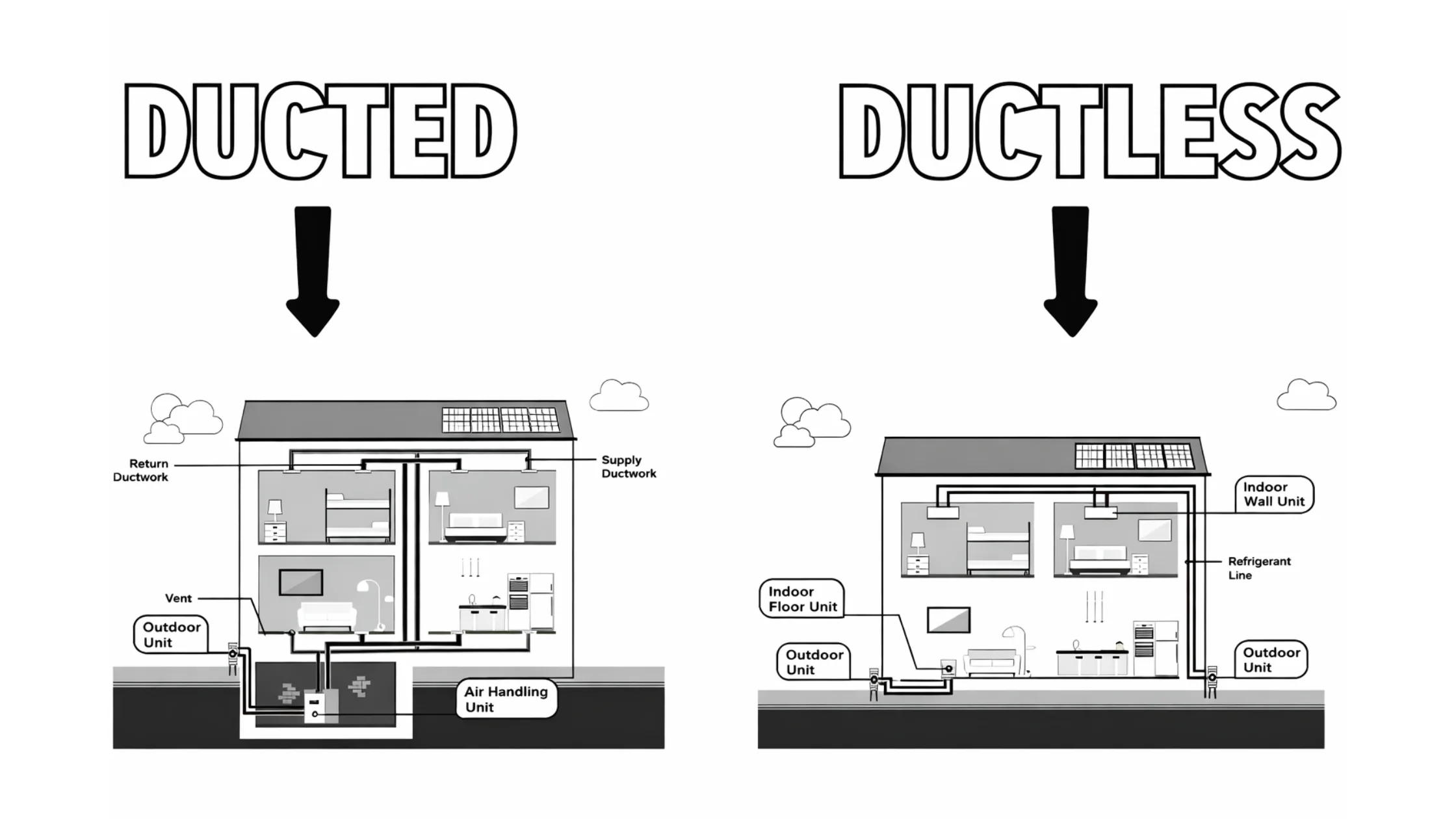
If you are comparing heat pumps for a Colorado home, the real choice is usually not "heat pump or mini split." A mini split is a type of heat pump. The bigger question is whether your home should use a ducted system that connects to central ductwork or a ductless system that sends heating and cooling directly into specific rooms.
Both can work well on the Front Range. Both can heat and cool efficiently when the equipment is selected for Colorado weather. The best answer depends on the house, not just the equipment brochure.
Here is how to compare ducted and ductless heat pumps in plain language.
The Short Answer
A ducted heat pump usually makes the most sense when your home already has usable ductwork and you want whole-home comfort from one central system.
A ductless mini split usually makes more sense when the home has no ducts, the ducts are hard to extend, one part of the house is uncomfortable, or you want room-by-room zoning without rebuilding the whole HVAC system.
The decision gets more nuanced in Colorado because winter performance matters. ENERGY STAR notes that cold-climate air-source heat pumps are tested for low-temperature performance at 5 F, and Colorado homeowners should work with a contractor who understands how that performance applies to the home's heating load.
What Is a Ducted Heat Pump?
A ducted heat pump looks and feels familiar if you already have central air or a forced-air furnace.
The outdoor unit connects to an indoor air handler or coil, and the system moves heated or cooled air through the existing ductwork. ENERGY STAR describes ducted air-source heat pumps as systems that can connect to the conventional forced-air ductwork found in many American homes.
That makes ducted heat pumps appealing for many Colorado houses built with central HVAC. If the duct system is in good condition, a ducted heat pump can often deliver whole-home heating and cooling with fewer visible indoor components.
Ducted works best when:
- The home already has central ductwork
- The ducts are properly sized and reasonably sealed
- You want one integrated system for most or all rooms
- You prefer hidden air distribution instead of wall-mounted indoor heads
- The existing furnace or air conditioner is already due for replacement
The catch is that ductwork matters. A great heat pump connected to leaky, undersized, or poorly balanced ducts will still struggle.
What Is a Ductless Heat Pump?
A ductless heat pump, often called a mini split, uses an outdoor unit connected to one or more indoor air handlers. Those indoor units may be mounted on a wall, ceiling, or floor depending on the equipment and room layout.
The U.S. Department of Energy says ductless minisplits are a strong option for homes without ducted heating systems, room additions, and efficient new homes that only need a small space conditioning system.
Because the system does not need ducts, it can solve comfort problems that central HVAC cannot reach easily.
Ductless works best when:
- A room addition does not connect cleanly to the central system
- A garage apartment, basement, sunroom, office, or bonus room needs its own control
- The home uses radiant, boiler, baseboard, or other non-ducted heat
- Running new ducts would be expensive or disruptive
- You want independent temperature control in specific zones
Mini splits can also avoid duct losses. DOE notes that duct losses can account for more than 30% of space conditioning energy use, especially when ducts run through unconditioned spaces such as attics.
When a Mini Split Makes More Sense Than Central HVAC
A mini split makes the most sense when the comfort problem is specific and the central system is either unavailable or not worth extending.
Think about a finished basement that stays cold in January, a second-floor office that overheats in July, or a room over a garage that never feels right. Extending ductwork to those spaces may require framing changes, drywall repairs, insulation work, and airflow balancing.
In those cases, a ductless mini split can be the cleaner solution.
It can also be the better fit for older Colorado homes that were never designed for central air. Many homes with boiler heat or baseboard heat do not have ducts at all. A ducted heat pump would require a full duct system, while a ductless system can usually be installed with less disruption.
That does not mean ductless is always cheaper. A one-zone mini split may be a smaller project than central HVAC. A multi-zone ductless system serving most of a house can become a larger project once you add several indoor heads, line sets, condensate routing, controls, and electrical work.
The right question is not "Is ductless cheaper?"
The better question is: "Which system solves the rooms that actually need help?"
When Ducted Makes More Sense
A ducted heat pump often makes more sense when the house already has good central ductwork and the goal is whole-home comfort.
If the ducts are inside conditioned space, sized correctly, and delivering airflow evenly, using them can be practical. You get one central system, familiar filters and controls, and fewer visible indoor units.
Ducted can also pair well with an existing furnace in a dual-fuel setup. ENERGY STAR notes that a heat pump can be considered when adding or replacing central air, and a dual-fuel system can use the heat pump or furnace based on the best fit for the conditions.
For some Colorado homeowners, that is a sensible bridge. The heat pump handles much of the year, and the furnace remains available for backup during the coldest periods or when utility costs make that approach attractive.
Colorado Factors That Should Shape the Decision
Colorado homes are not all the same. A ranch in Longmont, a foothills home near Boulder, and a two-story house in Fort Collins may have very different heating loads, duct layouts, insulation levels, and solar exposure.
Before choosing ducted or ductless, look at these factors.
Winter heating performance
Cold-climate performance matters more here than it does in mild coastal climates. ENERGY STAR's cold-climate criteria include low ambient performance at 5 F, including coefficient of performance and heating capacity requirements.
That does not mean every home needs the same equipment. It means the contractor should check the specific model's low-temperature output against the home.
Existing duct condition
Ducted only makes sense if the ducts can move the right amount of air to the right rooms.
If the ducts are leaky, undersized, routed through a cold attic, or badly balanced, a central heat pump may need duct sealing, duct modifications, or a different approach.
Room-by-room comfort
Mini splits are strong when different spaces need different temperatures. Bedrooms, home offices, additions, and rooms over garages are common examples.
That zoning control can be valuable in Colorado homes with strong sun exposure on one side of the house and shaded rooms on the other.
Appearance and layout
Some homeowners do not mind indoor mini split heads. Others prefer the cleaner look of central registers.
This is not just cosmetic. Indoor head placement affects comfort, airflow, noise, condensate routing, and service access.
Project scope
A ducted replacement can be straightforward if the existing system and ducts are ready. A ductless project can be straightforward if it serves one or two clear zones.
Either option can become more involved when electrical work, structural routing, multiple zones, or duct repairs are needed.
The Load Calculation Is Not Optional
For Colorado homes, sizing should not be based only on square footage or the size of the old furnace.
ACCA identifies Manual J as the ANSI-recognized standard for residential heating and cooling load calculations. That matters because a heat pump has to be selected for the actual heat loss and heat gain of the home.
Oversizing can create short cycling, comfort swings, and unnecessary cost. Undersizing can leave the system leaning too hard on backup heat during cold weather.
A good contractor should be able to explain:
- The home's heating and cooling load
- Whether the proposed equipment can meet that load at low outdoor temperatures
- Whether backup heat is recommended
- Whether the existing ducts can support the airflow
- Whether a room-by-room ductless layout would solve the problem better
Simple Decision Guide
Choose a ducted heat pump if:
- Your home already has good ductwork
- You want whole-home heating and cooling
- You prefer a central system with fewer visible indoor units
- Your duct system can be sealed, balanced, and matched to the new equipment
Choose a ductless mini split if:
- Your home has no ductwork
- One or two rooms are the main comfort issue
- You are conditioning an addition, office, garage apartment, basement, or bonus room
- New ductwork would be difficult or expensive
- You want independent room control
Consider a mixed approach if:
- Most of the home works well with central HVAC, but one area does not
- You want a ducted heat pump for the main house and a mini split for a problem zone
- Your remodel creates spaces that the central system cannot serve well
The Bottom Line
Ducted and ductless heat pumps can both be excellent choices for Colorado homes. The best option depends on the home's ductwork, layout, comfort problems, winter heating load, and how much zoning control you want.
If the ducts are good and the goal is whole-home comfort, ducted may be the cleanest fit. If the home has no ducts or one area needs targeted help, a mini split may make more sense than central HVAC.
The equipment type matters, but the design matters more.
At Peak Comfort
We help Colorado homeowners compare ducted heat pumps, ductless mini splits, and mixed-system options without forcing every house into the same answer.
If you are not sure which path fits your home, we can look at your ductwork, comfort complaints, heating load, and equipment options, then explain the tradeoffs clearly. No pressure, just practical guidance for the way your house actually works.
About the Author
Morgan Shaffer
Co-Owner and HVAC Specialist, Peak Comfort
Morgan specializes in high-efficiency systems, heat pumps, and field-proven HVAC solutions for Front Range weather.
References
APA style citations for sources used in this article.
- U.S. Department of Energy. (2026, May 14). Ductless minisplit heat pumps. https://www.energy.gov/energysaver/ductless-minisplit-heat-pumps Source
- ENERGY STAR. (n.d.). Air-source heat pumps. https://www.energystar.gov/products/air_source_heat_pumps Source
- ENERGY STAR. (n.d.). Heat pump equipment key product criteria. https://www.energystar.gov/products/air_source_heat_pumps/key-product-criteria Source
- Air Conditioning Contractors of America. (n.d.). Manual J residential load calculation. https://www.acca.org/standards/technical-manuals/manual-j Source