
Why Is My AC Freezing Up in Colorado? Safe Checks Before You Call
Published October 8, 2026. Added to our weekly archive for the date shown above. Guidance and sources were checked at publication.
Ice on your Colorado air conditioner is a warning sign. Learn what to turn off, which airflow checks are safe, and when repeated freezing needs professional repair.
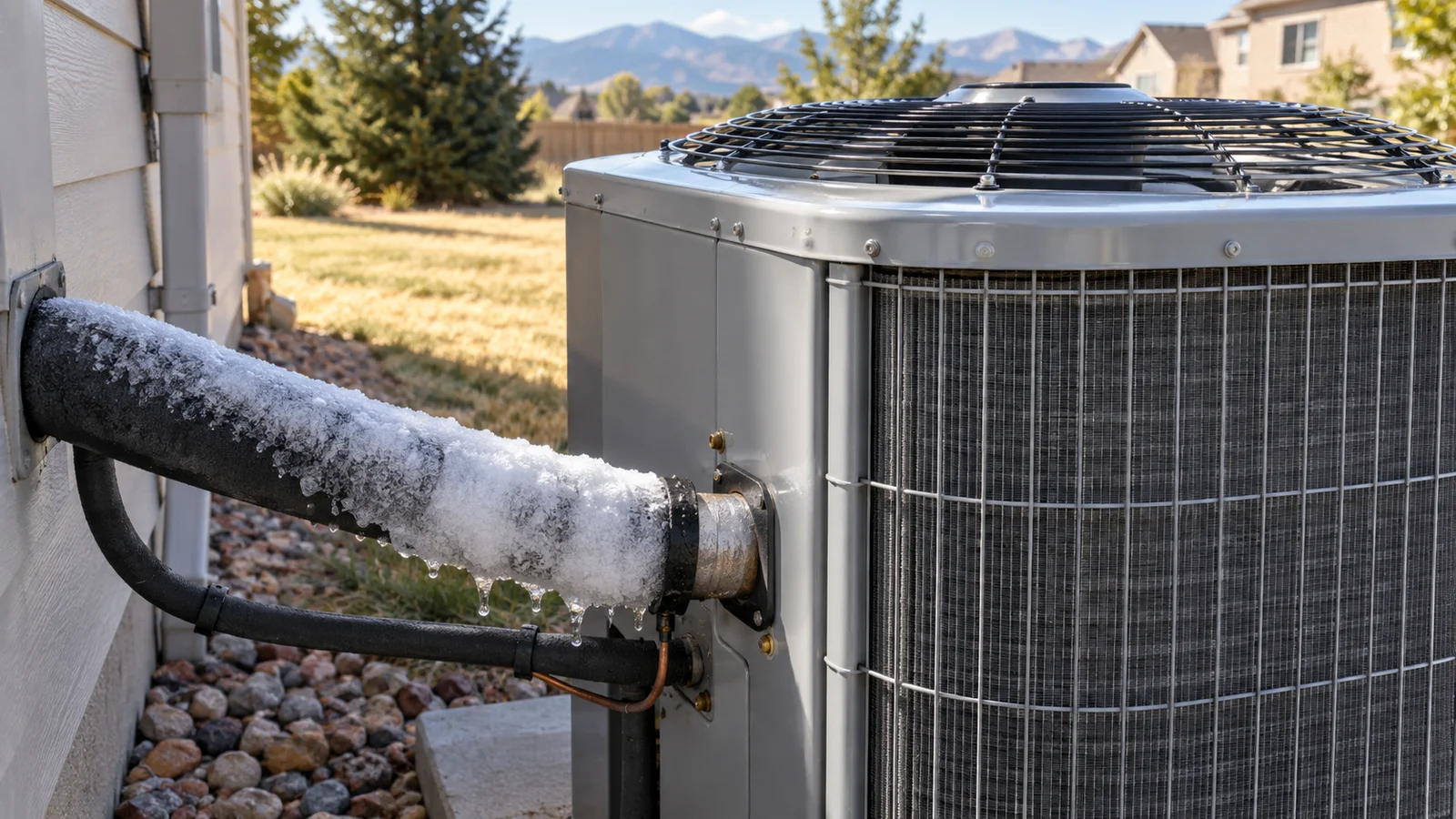
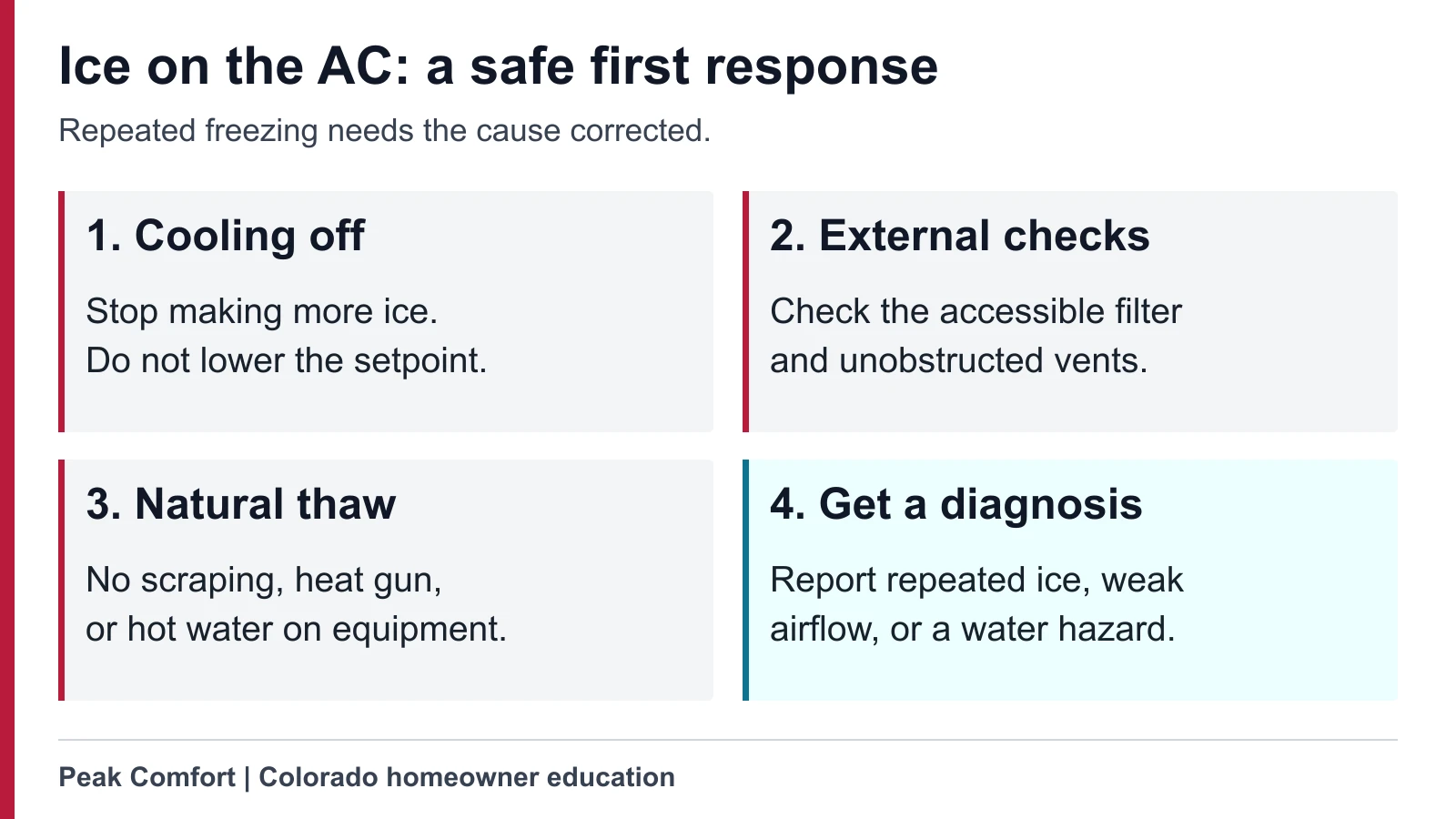
If your air conditioner has ice on the refrigerant line or indoor coil, turn cooling off. Check the accessible filter and unblocked vents, let the system thaw naturally, and arrange professional diagnosis if it freezes again. Ice does not mean the AC is cooling especially well.
A late-summer Front Range afternoon can still leave the house hot while the equipment is covered in frost. That combination makes sense once you understand the problem: a frozen indoor coil cannot exchange heat with the home's air properly.
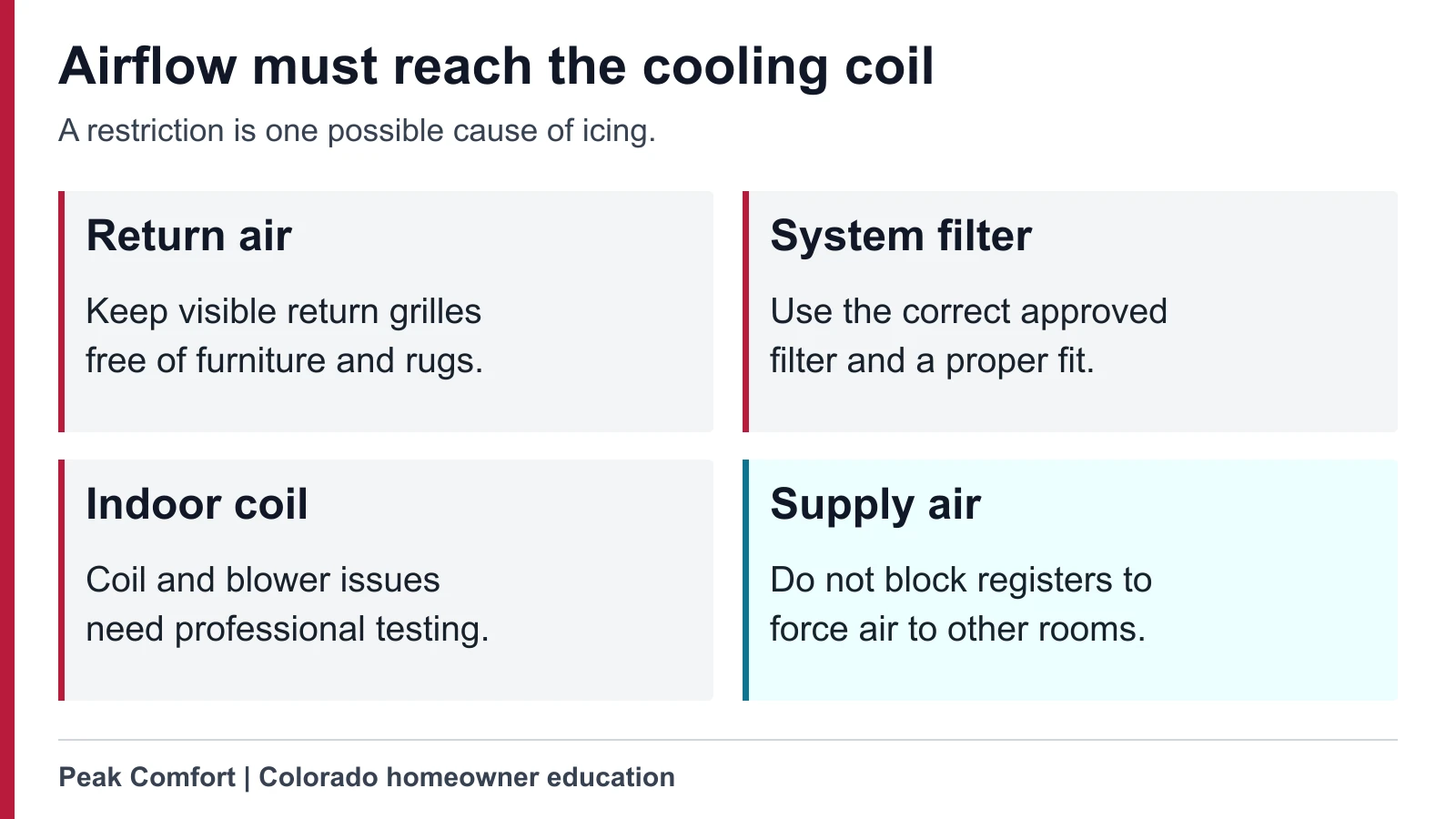
Carrier's frozen-AC guidance identifies airflow restrictions, refrigerant problems, and mechanical faults as possible causes. The first goal is to stop adding ice. The next is to identify why it formed, rather than restarting the system every time it melts.
What does ice on an AC actually tell you?
The indoor evaporator coil is normally cold during cooling. If operating conditions let it fall below freezing, moisture can freeze on its surface. Ice may also become visible along the larger refrigerant line outside.
It is a symptom, not a complete diagnosis. A dirty filter can be involved, but so can a dirty coil, inadequate blower airflow, or a refrigerant fault. You cannot determine the refrigerant charge from a photograph of ice.
Do not confuse this with a heat pump's outdoor defrost cycle in heating mode. Summer ice at the indoor cooling coil and winter frost on a working outdoor heat pump are different situations. Our heat pump defrost guide explains the winter case.
What can you safely do right now?
Start at the thermostat and accessible external components. Leave refrigerant fittings, electrical compartments, and the coil cabinet to a technician.
- Stop cooling. Lowering the setpoint will not melt the ice or correct the cause.
- Check for a water hazard. Thawing ice can produce water. If water is near electrical components, do not operate the system; arrange service.
- Inspect the accessible filter. Use the replacement type and size specified for the equipment. Do not run without a filter as a routine workaround.
- Check visible returns and registers. Move furniture or rugs blocking them. Do not adjust hidden dampers without understanding the system.
- Allow natural thawing. Do not chip ice, apply a heat gun, or pour hot water on the equipment.
- Record what happened. Note when cooling weakened, any recent filter change, and whether ice returns after a complete thaw.
Carrier describes using fan-only operation to assist thawing. Use that option only if the blower operates normally, there is no water or electrical concern, and your equipment instructions permit it. If those conditions are unclear, leave the system off and call.
There is no dependable universal thawing time. Heavy icing, cabinet conditions, and airflow all affect it. A clock running out is not proof that the coil is clear.
Which observations are useful, and which need testing?
| Observation | Useful information to give a technician | Avoid concluding |
|---|---|---|
| Airflow fell after a filter upgrade | Old and new filter type and dimensions | Every higher-MERV filter is unsuitable |
| Ice returns with a clean approved filter | Thawing and recurrence details | The system only needs more refrigerant |
| Blower is quiet and vents have little airflow | Whether the fan runs in fan-only mode | The thermostat must be broken |
| Water appears below the indoor unit | Location and whether it followed thawing | It is harmless condensation |
| Some rooms stay hot while others cool | Which rooms and how long it has occurred | Closing more registers will fix it |
These observations help organize a diagnosis. They do not replace measurements or authorize opening equipment.
Trane's coil troubleshooting guide also directs homeowners with coil icing to professional service. If your AC has frozen repeatedly, ask for the cause and corrective work in writing.
Why can a Colorado AC freeze when it is hot outside?
Outdoor heat does not prevent an indoor coil from getting too cold. The indoor coil depends on sufficient warm return air passing over it and on correct refrigerant-system operation.
For a Northern Front Range home, useful history might include a recent smoke-season filter upgrade, renovation dust, rooms closed off during a remodel, or an airflow problem that existed before the hot weather. Those are questions to investigate, not a claim that Colorado's altitude or dry air caused your particular failure.
If you recently replaced a filter, keep the packaging. If construction occurred, tell the technician which rooms were affected and whether the system ran during the work. If you have always had a weak upstairs return, explain that too. A short equipment history is more helpful than guessing which part needs replacement.
What should an AC repair diagnosis explain?
Ask the technician to separate an airflow finding from a refrigerant finding. A useful explanation connects the symptom to evidence and the proposed repair.
For example, if the recommended work is a blower repair, ask how the blower problem was confirmed. If a refrigerant addition is proposed, ask why the charge was low and whether a leak investigation is needed. If duct work is proposed, ask what measurements support it and which comfort issue it is intended to solve.
You do not need to become a refrigeration technician. You do need a clear answer to three customer questions:
- What caused the freezing?
- What work addresses that cause?
- How will normal operation be checked afterward?
The ENERGY STAR maintenance checklist includes cooling-coil, blower, refrigerant, and drain checks. Use those categories as a conversation starter rather than a guarantee that every repair requires every service.
Does repeated freezing mean you need a new system?
Not automatically. The cause, repair scope, equipment condition, and other comfort problems should guide the choice. Ice alone is a poor reason to approve a full replacement.
If replacement is being discussed, compare it with a documented repair option and read our repair-or-replace guide. If the original system has always struggled with airflow or room balance, include those issues in the replacement design rather than buying the same configuration again.
Questions homeowners ask about frozen AC
Can I keep running cooling until the house is comfortable?
No. Continued cooling can add to the icing and put the equipment at risk. Turn cooling off and address the cause before returning to normal use.
Will a new filter definitely fix it?
Only if the filter restriction was the cause and no other problem remains. Repeated icing after a compatible filter change needs professional evaluation.
Should I scrape off the ice to speed things up?
No. Tools can damage delicate surfaces or refrigerant lines. Let it thaw naturally and protect the surrounding area from water without opening equipment.
What should I tell the office when scheduling?
Say that the AC is freezing, whether it has happened before, where you can see ice, and whether water or electrical concerns are present. Mention weak airflow and any recent filter or thermostat change.
Get the cause corrected
Stopping cooling protects the equipment while you arrange a clear diagnosis. Do the safe external checks, document the sequence, and do not treat repeated thawing as a repair.
Peak Comfort provides air-conditioning service in Colorado. Request help with a freezing AC so we can evaluate the equipment and explain the appropriate next step for your home.
The cover is an original generated illustration. The graphics are educational diagrams, not measurements from a specific system.
About the Author
Morgan Shaffer
Co-Owner and HVAC Specialist, Peak Comfort
Morgan specializes in high-efficiency systems, heat pumps, and field-proven HVAC solutions for Front Range weather.
References
APA style citations for sources used in this article.