
Wildfire Smoke in Colorado: Is Your HVAC Filter Actually Helping?
Published October 8, 2026. Added to our weekly archive for the date shown above. Guidance and sources were checked at publication.
Choose a smoke-ready HVAC filter for your Colorado home, understand MERV 13 and airflow limits, and know when a portable air cleaner is the better next step.
For wildfire smoke, use a well-fitting MERV 13 HVAC filter if your system can support it. If it cannot, a correctly sized portable air cleaner is often a better next step than forcing a restrictive filter into the furnace. Filtration helps reduce airborne particles; it does not make a home smoke-proof or replace evacuation instructions.
Along Colorado's Northern Front Range, a smoky day can turn a familiar cooling routine into a difficult choice: open the windows for relief, keep running the AC, or buy the highest-rated filter on the shelf? The right answer starts with how your particular home moves and filters air.
The EPA's wildfire guidance recommends combining compatible HVAC filtration with a portable cleaner when needed. Before buying equipment, separate three jobs: limiting smoke entry, filtering indoor particles, and maintaining a safe indoor temperature.
What does MERV 13 mean, and what does it leave out?
MERV is a laboratory rating for a filter's ability to capture particles in different size ranges. It is not an airflow rating, a whole-house air-quality score, or a promise that the filter removes every component of smoke.
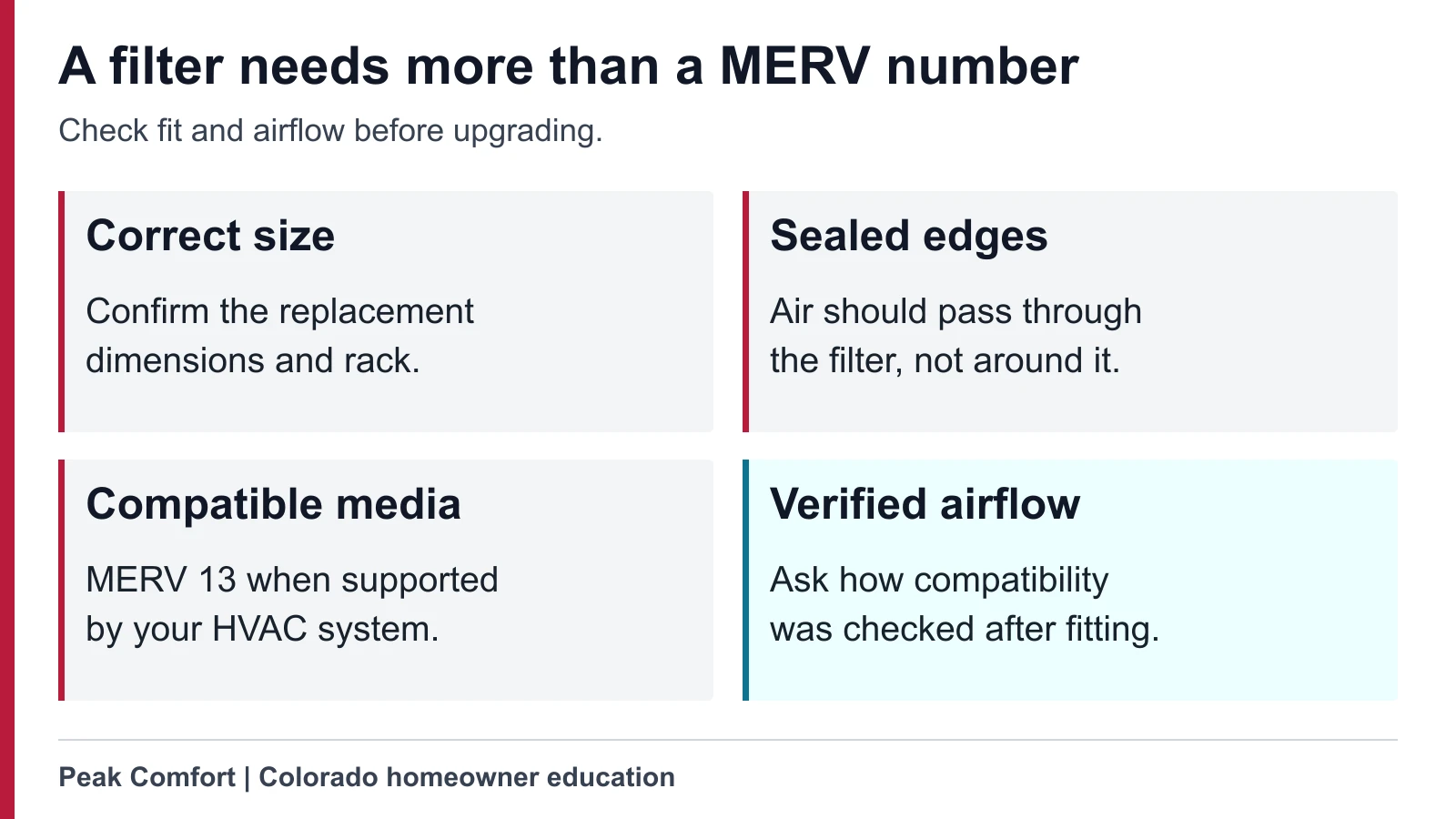
The EPA explains MERV ratings and recommends MERV 13, or the highest efficiency your system can accommodate. That last phrase matters. A filter must fit the rack, seal at the edges, and work with the blower and duct system.
Two filters with the same MERV number can have different dimensions and resistance. A thicker media cabinet may offer options that a narrow one-inch rack does not. Treat the rating and the installation as separate checks.
Before ordering, photograph the existing filter label and rack. Record the nominal size printed on the packaging and confirm the actual replacement dimensions. A filter that slides in but leaves an edge gap can let air bypass the media.
Should you upgrade the furnace filter or buy a portable cleaner?
Start with the space you need to improve. Whole-house HVAC filtration serves the rooms connected to the system. A portable cleaner gives you a separate way to filter air in a bedroom, office, or other frequently occupied room.
| Your situation | A sensible next step | What to verify |
|---|---|---|
| The furnace supports a MERV 13 filter | Use the correct replacement and inspect the fit | Model guidance and airflow after installation |
| Filter compatibility is unclear | Keep the approved filter while arranging an airflow check | Filter rack, blower settings, and duct resistance |
| One room needs extra filtration | Add a portable cleaner sized for that room | Particle clean air delivery rate and operating noise |
| Your home uses ductless mini splits | Consider separate room filtration | The mini split's filter is not automatically smoke filtration |
| Closing windows makes the house dangerously hot | Seek a cooler, cleaner location | Local heat, smoke, and emergency guidance |
This is a decision framework, not a shopping ranking. A unit that is too loud to run while you sleep may be a poor practical choice even if its maximum setting looks impressive on paper. Compare performance at the setting you will actually use.
What should you do during a smoky day?
Use outdoor air-quality information for your location rather than the appearance of the mountains alone. Conditions can change during the day. Follow local public-health and emergency instructions, particularly if anyone in the household has a medical reason to limit exposure.
For indoor air, establish a simple routine:
- Identify where household members will spend the most time.
- Keep the compatible filter and portable cleaner working in those spaces.
- Check whether your equipment has an outdoor-air intake or recirculation setting.
- Watch indoor temperature as well as air quality.
- Reassess ventilation when outdoor conditions improve.
Do not seal combustion-air openings or permanently disable required ventilation. If you cannot identify an intake's purpose, ask an HVAC professional before changing it. A central AC, an evaporative cooler, and a single-hose portable AC do not handle outdoor air in the same way.
For broader context beyond smoke, see our Colorado indoor-air-quality guide. This article focuses on particle filtration and equipment fit rather than every indoor-air concern.
How do you set up a cleaner room without overcomplicating it?
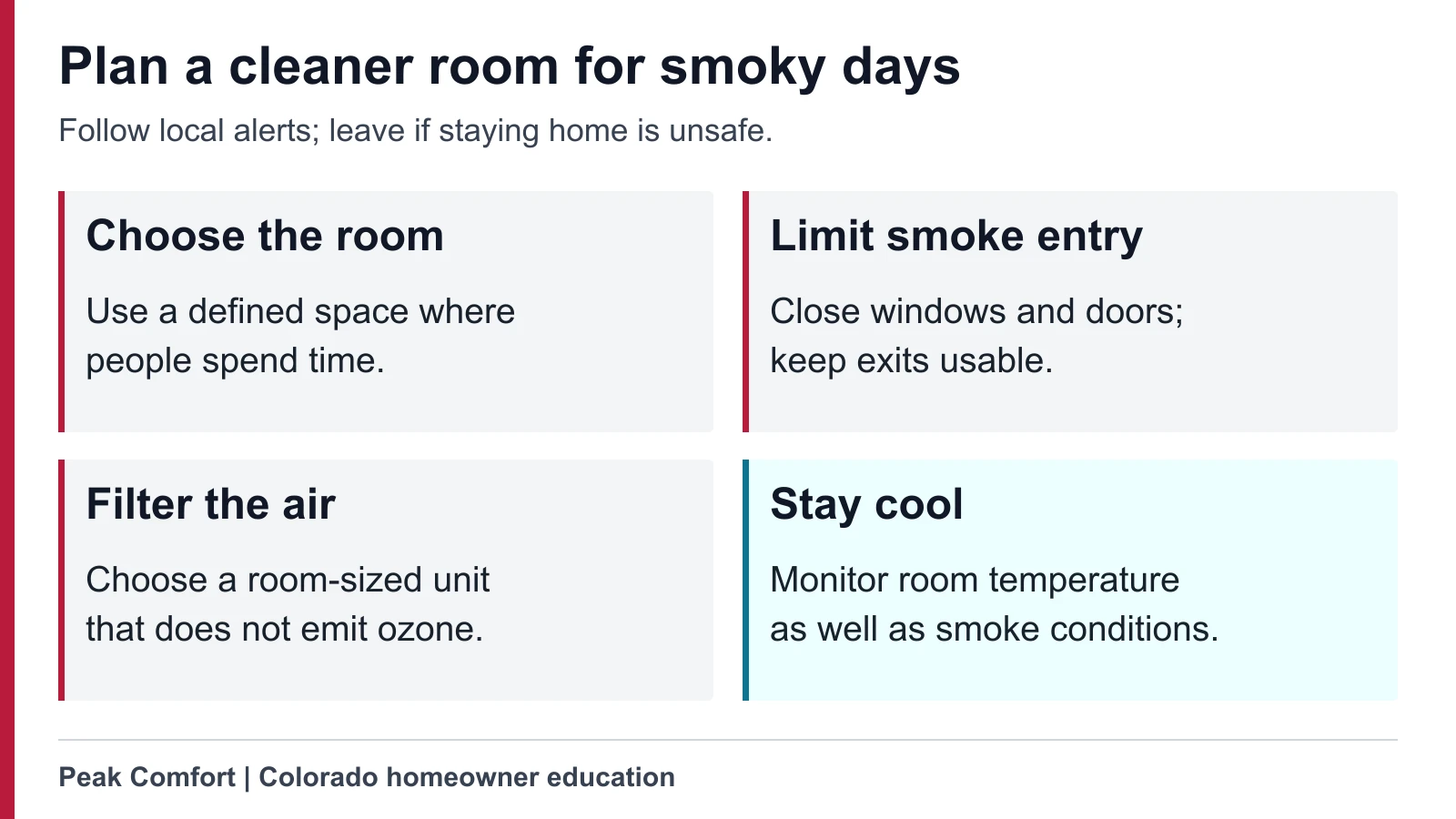
The EPA's clean-room guidance describes using a room with closed windows and doors and a suitable portable air cleaner. Choose equipment that does not intentionally produce ozone. Give its intake and outlet the clearance specified by the manufacturer.
In a Front Range home, a bedroom can be a practical starting point because it is a defined space used for many hours. Measure the room before choosing the cleaner. Include an open adjoining area if air moves freely between the spaces; a small-room rating does not automatically cover an open floor plan.
Think through everyday use, too. Keep the outlet away from curtains. Place the cleaner where it will not create a trip hazard. Make replacement filters easy to identify and obtain. Decide who will check the unit after a heavy-smoke period.
What changes mean your HVAC filter needs a closer look?
Inspect according to the equipment instructions and check more closely during heavy smoke. There is no universal replacement interval that fits every filter, house, and smoke event.
A new whistle, noticeably weaker airflow, or a comfort problem that appeared immediately after a filter change deserves attention. Those observations do not prove the filter is the only cause. Record the old and new filter specifications and ask for an assessment rather than repeatedly switching products.
For a useful service visit, bring these questions:
- Is this filter approved for the rack and blower arrangement?
- Is air leaking around the media?
- What did you measure to confirm acceptable airflow?
- Would a different media cabinet solve a real limitation here?
- Would room filtration meet our immediate goal more simply?
Questions Colorado homeowners ask
Is MERV 13 always better than MERV 8?
It offers greater particle-capture performance in the rated ranges, but compatibility still determines whether it is appropriate for your HVAC system. A higher number does not justify an incorrect size or an unverified airflow restriction.
Does a portable HEPA cleaner replace the furnace filter?
No. The furnace still needs its specified filter for proper operation. A portable cleaner provides additional filtration for the room it serves, which can be useful when the central system has limitations.
Should I leave the HVAC fan running all day?
Ask whether continuous fan operation is suitable for your equipment and filter during a smoke event. It changes how much air passes through the central filter, but does not by itself stop outside air from entering the home.
Can a filter remove the smell and all gases in smoke?
Particle filtration and gas removal are different functions. Do not interpret a MERV rating or a reduced smell as proof that every pollutant has been removed.
The useful next step
Prepare before the next smoky day: identify your approved filter, choose a room-filtration plan if needed, and learn what the ventilation controls actually do. That is more useful than buying the densest filter without checking the system.
Peak Comfort serves Colorado's Northern Front Range. Request an HVAC airflow and filtration review if you need help matching a filter to your equipment, or explore our HVAC services when filtration changes reveal a broader comfort problem.
The cover is an original generated illustration. The diagrams explain general planning principles, not measured performance from a customer home.
About the Author
Morgan Shaffer
Co-Owner and HVAC Specialist, Peak Comfort
Morgan specializes in high-efficiency systems, heat pumps, and field-proven HVAC solutions for Front Range weather.
References
APA style citations for sources used in this article.