
What Humidity Should a Colorado Home Be in Winter?
Find a winter humidity setting for your Colorado home using indoor readings, window condensation, and humidifier controls, not a one-size-fits-all target.
There is no single winter humidity setting for every Colorado home. EPA gives 30% to 50% relative humidity as general indoor guidance, but cold windows can require a lower setting. Measure the room, follow your humidifier's cold-weather instructions, and reduce added moisture if condensation appears. Do not treat 50% as a winter goal.
For homeowners in Longmont, Loveland, Boulder, and Fort Collins, the useful question is not just whether the air feels dry. It is how much moisture the house can accommodate as outdoor temperatures fall. A setting that seemed comfortable on a mild October afternoon may need review during colder weather.
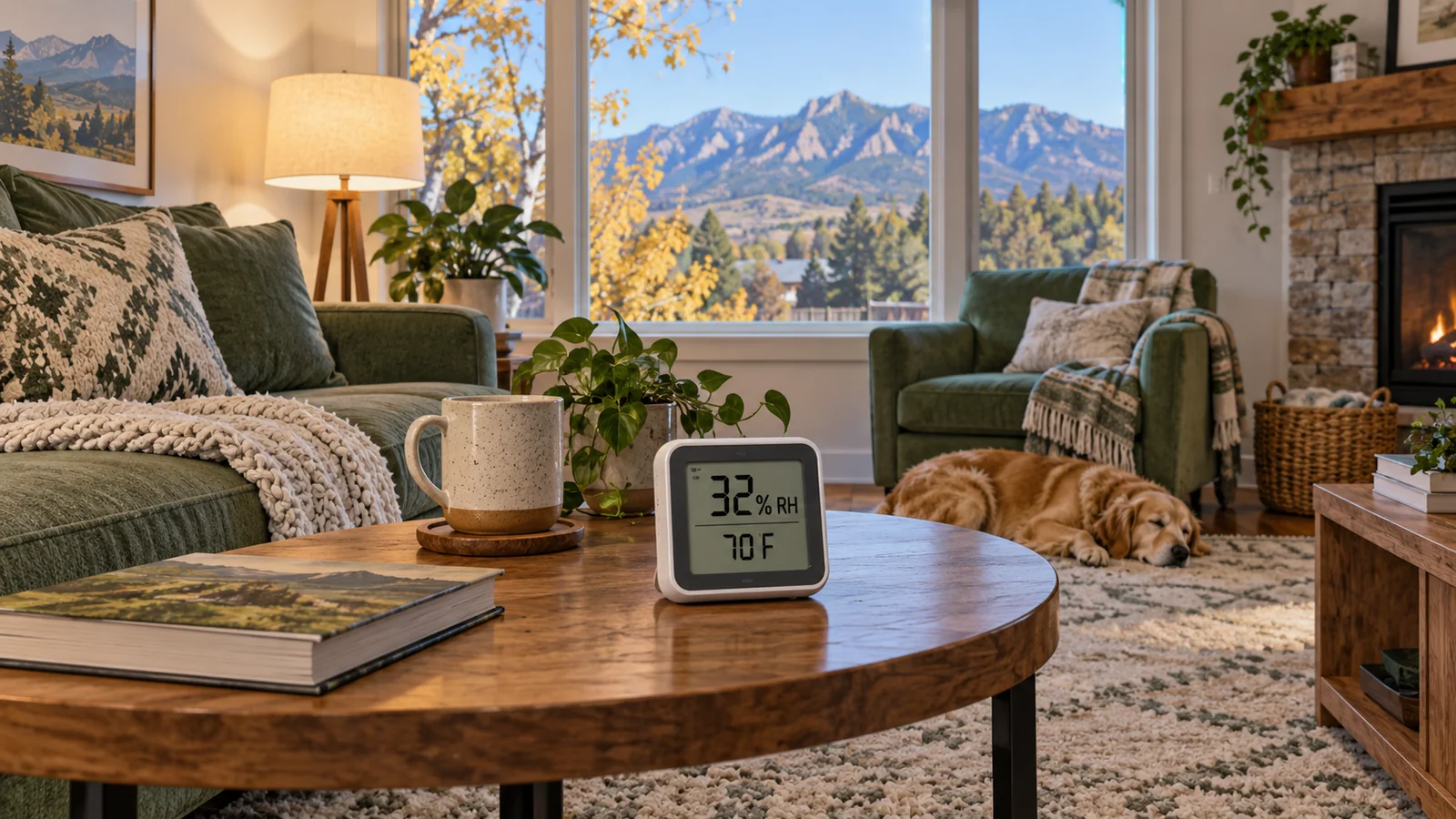
This guide is about making that adjustment thoughtfully, not selling every dry-feeling house a larger humidifier. The cover's meter reading is illustrative, not a recommended setting for your home.
Why does indoor air feel drier when heating starts?
Relative humidity, or RH, describes moisture relative to saturation at the air's current temperature. The National Weather Service explains that warming air lowers its relative humidity when its moisture content stays the same.
That distinction matters. Heating air does not, by itself, mean the furnace has extracted water from it. Cold outdoor air entering the house and warming indoors can have a low RH, even when the weather app reports a high outdoor percentage. Indoor and outdoor RH are not interchangeable readings.
A heat pump is not automatically a cure for winter dryness, either. Before changing heating equipment because of a humidity complaint, separate the room's moisture conditions from temperature, air leakage, ventilation, and the operation of any existing humidifier.
Is 30% to 50% always the right winter range?
No. The EPA's moisture guide describes that range as an ideal where possible, not a guarantee against condensation in every building.
The limitation is often a cold surface. The National Weather Service defines dew point as the temperature at which air reaches saturation. When moist room air meets sufficiently cold glass, water can collect there even though a meter elsewhere in the room shows a seemingly ordinary RH.
Window construction, indoor temperature, outdoor conditions, and the particular room all matter. That is why a generic outdoor-temperature chart should not override the instructions for your humidifier and house. A neighbor's setting is not a specification for your windows.
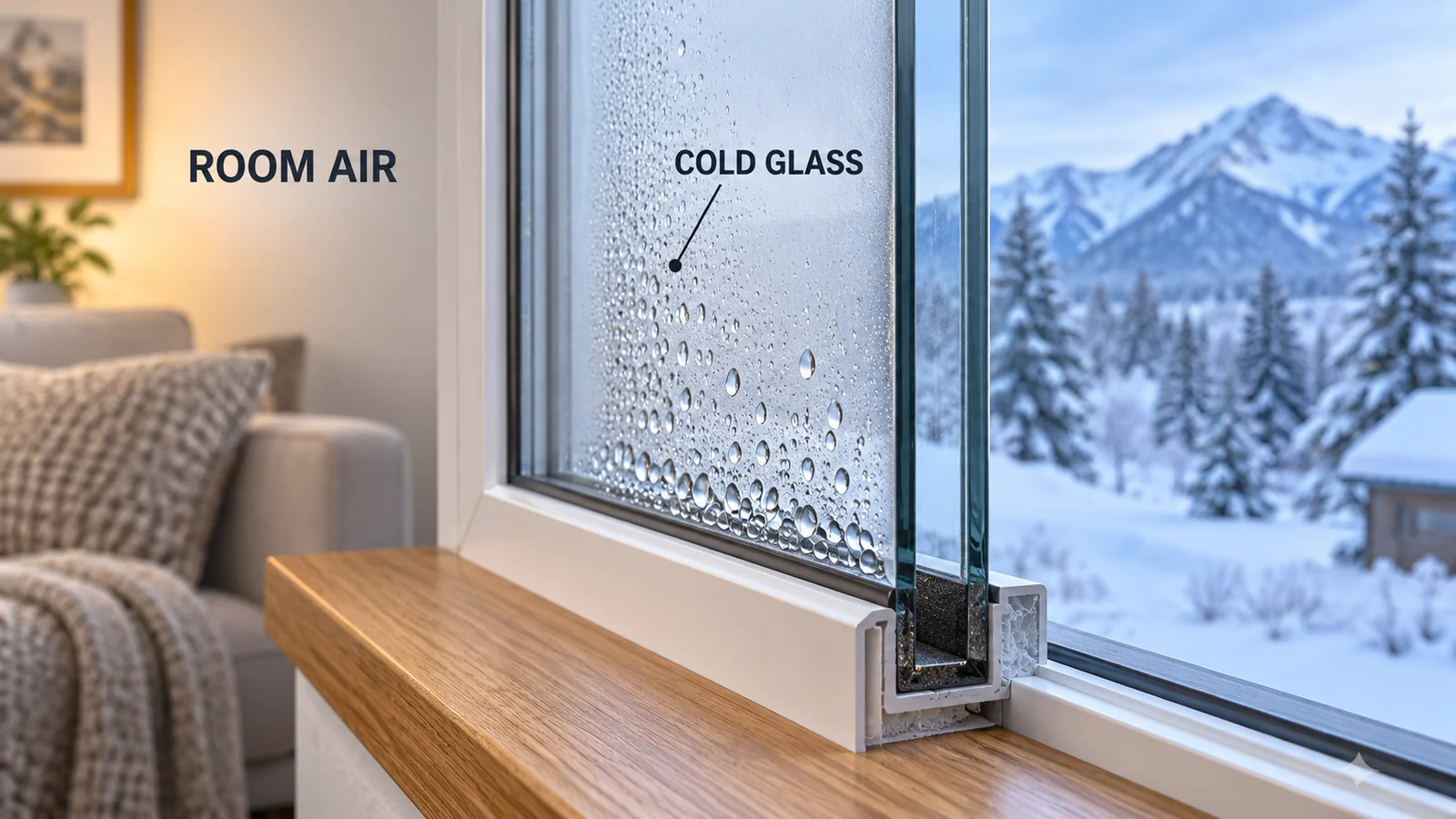
Condensation depends on both the moisture in the room air and the surface temperature. This illustration explains the relationship; it is not a window installation detail.
What should you check before turning the humidifier up?
Make a short record before making repeated changes. The goal is to give yourself, or a technician, a useful comparison.
- Measure where you spend time. Use a hygrometer according to its instructions, away from direct supply air, sunlight, and a humidifier's immediate output. Record room temperature as well as RH.
- Check the affected rooms. Do not assume a hallway thermostat represents a closed bedroom or basement. If two meters disagree, compare them side by side before drawing conclusions about the house.
- Look at the room-facing windows and sills. Record when moisture appears and whether it follows showers, cooking, or colder overnight weather. Wipe wet surfaces dry rather than letting water accumulate.
- Identify the control. Save the humidifier and control model numbers. Is it a manual humidity setting, an automatic outdoor-temperature-based control, or a portable appliance?
- Keep changes traceable. Note the original setting and follow the owner's instructions. Changing several controls at once makes the result difficult to interpret.
A log can be simple: date, room, temperature, RH, outdoor conditions, control setting, and visible moisture. You do not need a smart-home dashboard or a new thermostat just to begin observing the pattern.
What if the windows are wet but the house still feels dry?
Do not keep adding moisture to chase a more comfortable number. EPA's humidifier guidance says to reduce humidification when condensation occurs and not humidify above 50% RH. Its moisture guide also recommends promptly drying wet surfaces and addressing the moisture source.
Keep the distinction between a symptom and a diagnosis. Condensation on the room-facing glass is different from moisture trapped between panes or a leak around the frame. If the source is uncertain, have it evaluated rather than assuming the humidifier is responsible for every wet spot.
For recurring condensation, ask which part of the investigation concerns indoor moisture, HVAC controls, ventilation, or the window and building enclosure. An HVAC visit may not include window repair or a building-envelope assessment. Clarify that scope before booking.
Do not disable required ventilation or block combustion-air openings to retain humidity. A dry-air complaint does not justify changing an unidentified air opening.
Can automatic humidity control help during Colorado cold snaps?
It can reduce the need for repeated manual adjustments when the equipment is designed and configured for that purpose. AprilAire's control guidance explains how its automatic controls use outdoor-temperature information, while manual controls need adjustment as conditions change.
That is a product-specific example, not a promise that every smart thermostat has the same function. Ask whether your installed control actually receives outdoor-temperature information and how its condensation protection is configured. A weather display alone does not establish that the humidifier uses that information.
| Control or appliance | What it can help with | What you still need to check |
|---|---|---|
| Manual whole-home humidistat | Direct adjustment of the humidity setting | The model's cold-weather guidance and changing conditions |
| Compatible automatic humidity control | Adjusting operation using outdoor conditions | Sensor operation, configuration, and observed condensation |
| Portable room humidifier | Adding moisture in a particular occupied room | Local RH, damp surfaces, cleaning, and safe placement |
Use this comparison to discuss the controls you already have before buying an upgrade. Automatic operation is not a substitute for investigating persistent moisture.
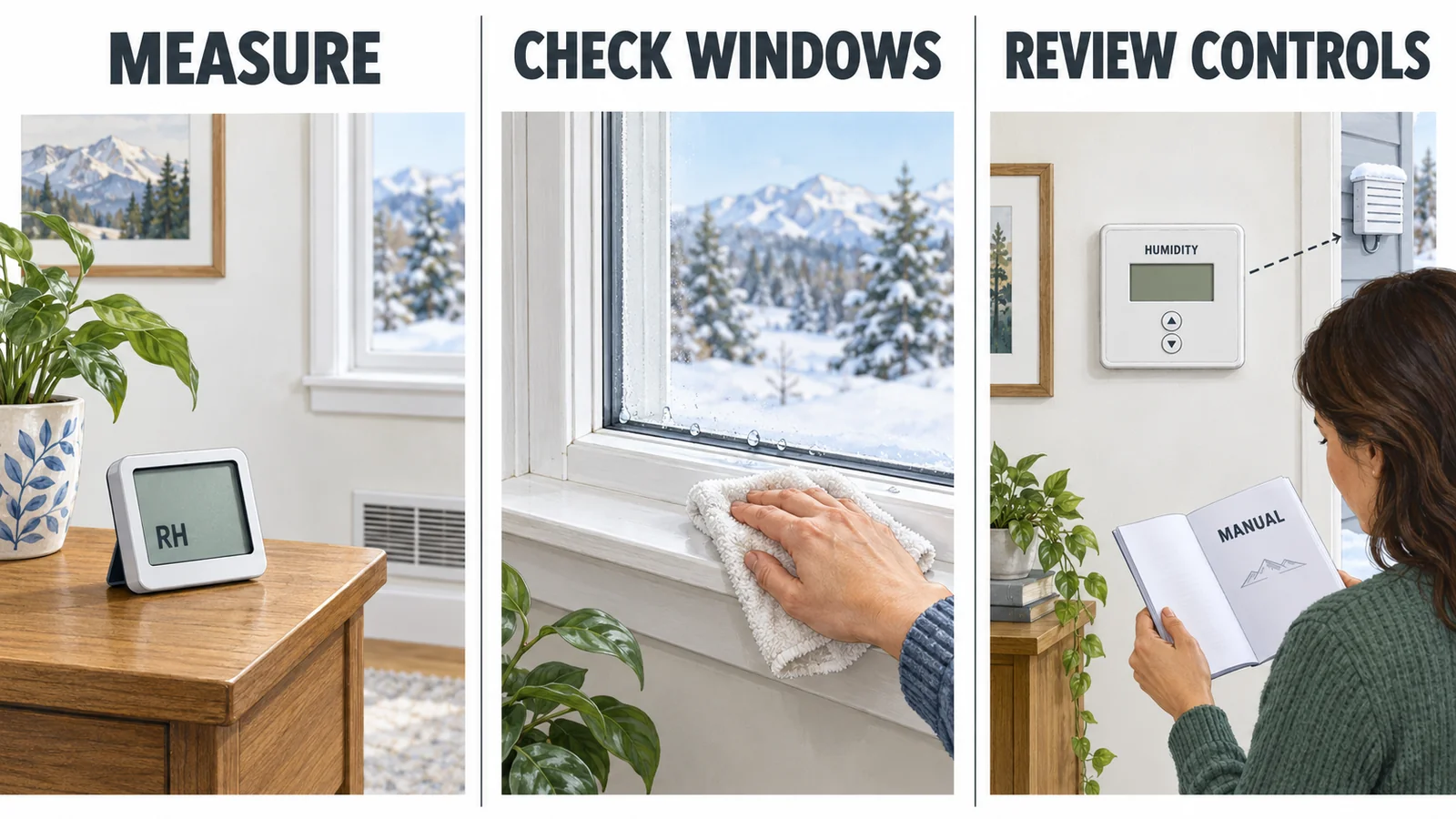
Measure the room, check surfaces, and review the appropriate control instructions. These steps are also described in the text above.
When is a humidifier service visit worth arranging?
Arrange a review if the system leaks, displays an unresolved fault, does not respond as its manual describes, or produces recurring condensation despite appropriate adjustments. Record whether the concern began after a control replacement, maintenance visit, remodel, or change in heating equipment.
Ask for an explanation of what was verified: the humidity reading, control response, water delivery, drainage where applicable, and compatibility with the heating system. Avoid approving a larger unit solely because the dial is high while the room reading is low. Output, controls, installation conditions, and the house need to be distinguished.
Keep homeowner maintenance within the manufacturer's instructions. EPA recommends daily water replacement and drying for portable tanks, cleaning portable units every third day, and following the specific maintenance instructions for central units. Do not apply a portable tank-cleaning procedure to a furnace-mounted or steam humidifier.
Water near electrical equipment or an active leak needs prompt attention, not another setting experiment. Leave wiring, hot components, plumbing changes, and equipment access beyond the owner's maintenance instructions to qualified service personnel.
Questions about winter humidity in Colorado
Should I use the weather app's humidity to set my humidifier?
No. Measure indoors. Outdoor RH describes air at outdoor temperature, not its RH after it enters and warms in the house.
Is more humidity always better for comfort?
No. Moisture that condenses on cold surfaces creates a different problem. Do not use humidification as a treatment for a medical condition or as a substitute for identifying a persistent moisture source.
Does one wet window prove the whole house is too humid?
Not by itself. Record the room's conditions and the location of the water. Surface temperature and local moisture sources can differ; a recurring problem needs an explanation specific to that location.
Should a whole-home humidifier run whenever the furnace runs?
Not necessarily. Operation depends on humidity demand, the control, and the equipment's approved sequence. Ask the installer to explain normal operation rather than forcing it on to match the heating cycle.
Find the setting that fits your house
Start with a room reading, watch the cold surfaces, and learn how your installed control should respond as weather changes. The best result is useful comfort without persistent condensation, not the highest percentage the equipment can produce.
Peak Comfort's Northern Front Range heating services include guidance on humidification for Colorado homes. Request help reviewing your heating and humidity controls, and tell us which rooms are affected, what you measured, and whether moisture is appearing. For broader particle-filtration questions, see our separate Colorado HVAC filter guide.
All three images are original generated illustrations, not customer photographs, measured test results, or product installation instructions.
About the Author
Morgan Shaffer
Co-Owner and HVAC Specialist, Peak Comfort
Morgan specializes in high-efficiency systems, heat pumps, and field-proven HVAC solutions for Front Range weather.
References
APA style citations for sources used in this article.
- U.S. Environmental Protection Agency. (n.d.). A brief guide to mold, moisture and your home. Source
- U.S. Environmental Protection Agency. (n.d.). Use and care of home humidifiers. Source
- AprilAire. (n.d.). Frequently asked questions. Source
- National Weather Service, Louisville. (n.d.). Discussion on humidity. Source
- National Weather Service, La Crosse. (n.d.). Dew point vs humidity. Source