
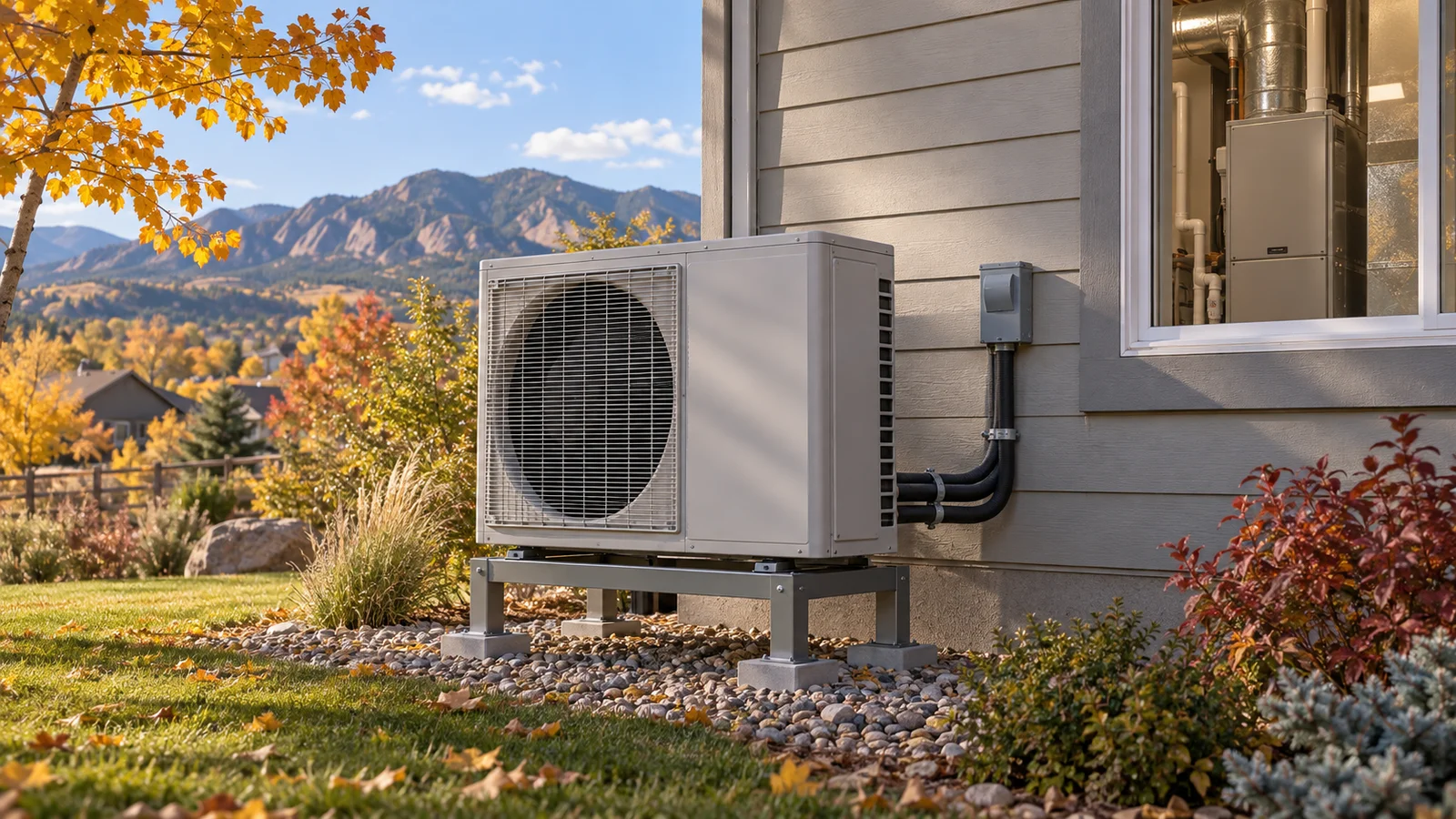
Dual-Fuel Heat Pumps in Colorado: When Should the Furnace Take Over?
Published October 8, 2026. Added to our weekly archive for the date shown above. Guidance and sources were checked at publication.
Compare dual-fuel heating in Colorado using heat-pump capacity, gas and electric rates, and control settings, with a clear example of the operating-cost math.
A dual-fuel system uses an electric heat pump and a fuel-burning furnace. The appropriate switchover depends on the home's heating load, the heat pump's output, energy rates, and approved controls. There is no single outdoor temperature that is right for every Colorado home.
If you have a serviceable gas furnace and an aging AC, a heat pump can be worth comparing with a conventional AC replacement. ENERGY STAR describes this dual-fuel option. The important question is not simply whether the heat pump can run in winter. It is how the two heat sources should work together in your house.
For Northern Front Range homeowners, fall is a useful time to review those settings and the assumptions behind a quote. A generic lockout temperature copied from another installation can leave you with a system that works but does not match your priorities.
What does dual fuel change about your heating system?
Trane defines dual fuel as a heat pump paired with a gas furnace. The heat pump can also cool the home in summer. During heating, controls select the appropriate source according to the equipment's design and configuration.
It does not mean the furnace and heat pump should always run at the same time. The sequence must be compatible with the specific equipment. Nor does a gas furnace give you heating during an ordinary electrical outage; its controls and blower still require power.
When discussing an upgrade, ask which indoor coil, outdoor unit, furnace, and thermostat are being matched. Keeping an existing furnace can be sensible, but only if its condition, airflow capability, and control compatibility support the plan.
Why are there two different balance points?
It helps to separate a capacity question from a cost question.
The thermal balance point concerns heat delivery: when does the heat pump's available output stop covering the home's heating demand on its own? That requires a load estimate and model-specific low-temperature performance data.
The economic balance point concerns running cost: when does one heat source cost less to deliver the same amount of useful heat? That requires energy prices and performance assumptions.
Those points can be different. A heat pump might be capable of heating the house at a temperature where gas is cheaper under your rate plan. A different customer, equipment model, or utility rate could change that result.
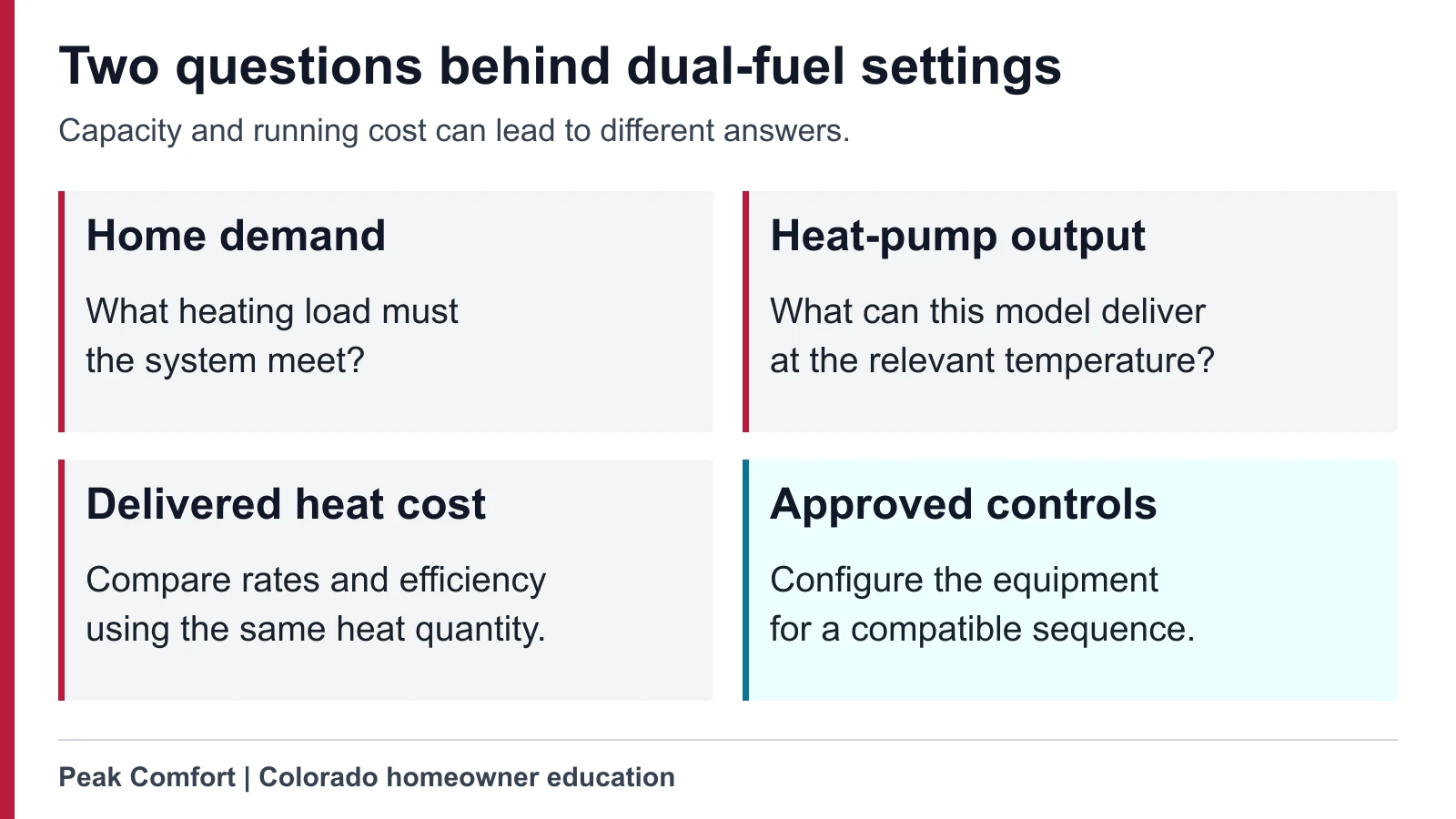
Ask the contractor which objective controls the proposed switchover: capacity, cost, comfort, emissions, or a combination. That makes the recommendation easier to evaluate.
How can you compare operating cost without comparing unlike units?
An electric bill charges for kilowatt-hours. A natural-gas bill may charge for therms. Comparing the price of one unit with the other directly does not tell you which heating source is cheaper.
Use a common quantity of delivered heat. The following simplified equations compare dollars per million British thermal units, abbreviated MMBtu. The EIA's conversion tools provide the underlying energy-unit conversions.
- Heat pump: electricity price per kWh multiplied by 293.1, divided by the heat pump's coefficient of performance, or COP.
- Gas furnace: gas price per therm multiplied by 10, divided by furnace efficiency expressed as a decimal.
COP describes heat output relative to electrical input at an operating condition. It changes with conditions; a seasonal rating is not the COP for every cold morning. Furnace AFUE can be a starting estimate in a simplified comparison, but installed operation and cycling affect real results.
What does a realistic comparison example look like?
The rates below are invented examples for explaining the math, not current Colorado utility prices. Assume electricity costs $0.16 per kWh, gas costs $1.20 per therm, and the furnace efficiency estimate is 95%.
| Heat source and assumption | Approximate cost per delivered MMBtu |
|---|---|
| Heat pump at COP 2 | $23.45 |
| Heat pump at COP 3 | $15.63 |
| Heat pump at COP 4 | $11.72 |
| Gas furnace at 95% efficiency | $12.63 |
Under those assumptions, the heat pump becomes cheaper when COP is roughly above 3.71. That does not tell you an outdoor switching temperature. You still need the exact equipment's performance data, the house's load, and the approved control strategy.
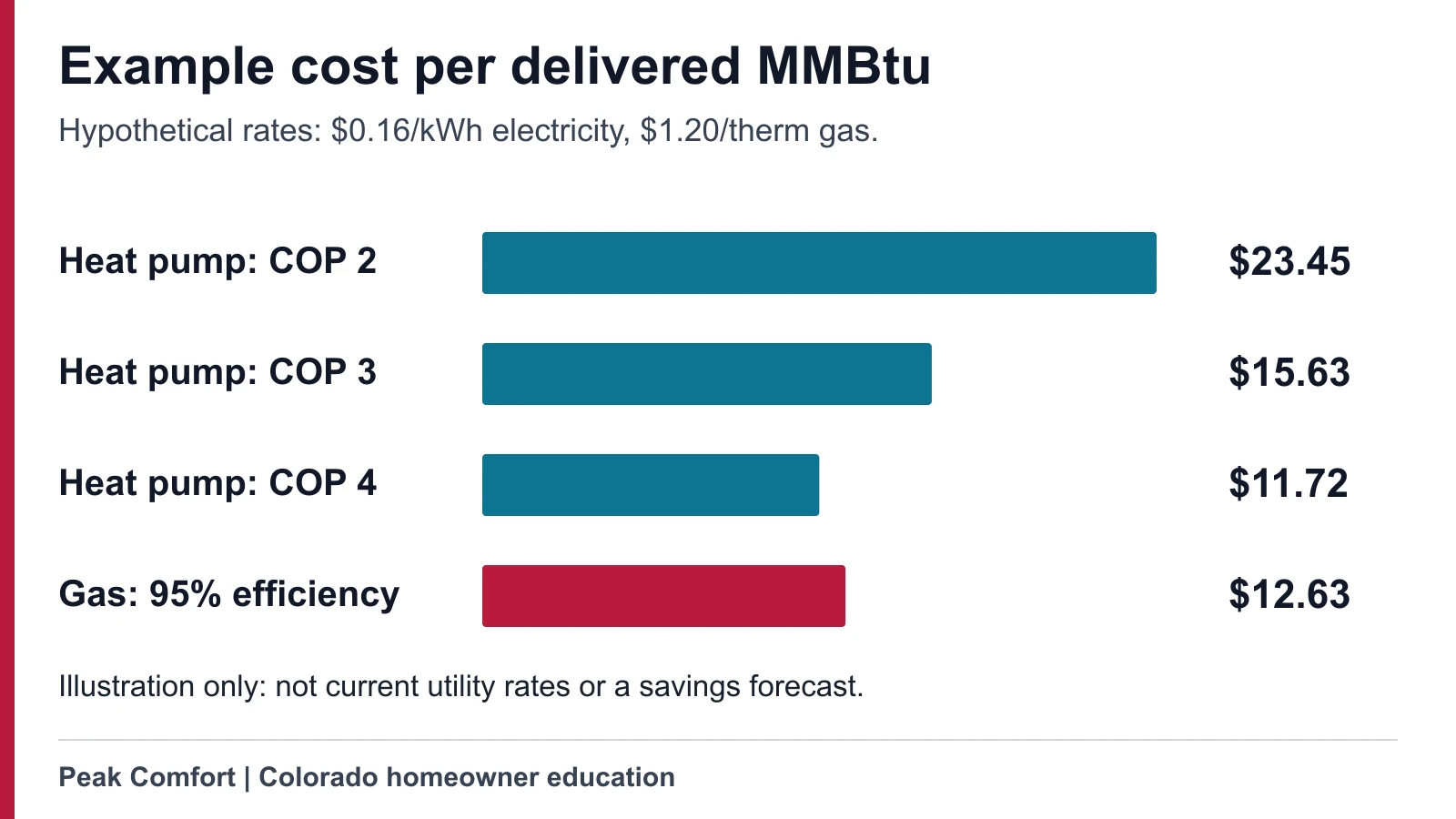
For your own comparison, include the variable supply and delivery charges that change with use. Account for time-of-use rates where applicable. A fixed gas customer charge generally remains if you keep gas service, even when the furnace runs less. This example also excludes installation cost, defrost effects, auxiliary electricity, maintenance, and distribution losses.
Use the calculation to ask better questions, not to predict an exact bill from a single COP number.
What belongs in a Colorado dual-fuel quote?
A strong proposal explains the design and commissioning, not just a heat-pump model and a rebate estimate. Ask for:
- The home's heating and cooling load assumptions.
- Exact matched indoor and outdoor equipment.
- Relevant low-temperature heating capacity and efficiency data.
- Furnace condition and compatibility if it is staying.
- Airflow and duct checks needed for the combination.
- Thermostat, sensor, lockout, and staging strategy.
- How the operation will be verified at installation.
- What should trigger a future control review.
Our Colorado HVAC sizing guide explains why square footage alone is not enough. For homes deciding how to distribute conditioned air, use the ducted-versus-ductless comparison.
What should you avoid changing yourself?
Do not experiment with installer-level lockouts or staging settings just because another homeowner uses a different temperature. A setting can interact with the equipment's operating limits and intended sequence.
Instead, photograph the ordinary thermostat display when a concern occurs. Note the outdoor temperature, indoor setpoint, active heat source, and whether the house is reaching the target. Share the record with the contractor.
If a rate plan changes, ask whether the economic assumptions should be updated. If the home is insulated or expanded, ask whether the capacity assumptions need review. Neither automatically means new equipment is required.
Questions about dual-fuel heating
Is 35 degrees always the right switching point?
No. A fixed rule ignores model performance, the home's load, utility rates, and control requirements. Ask for the basis of the setting proposed for your system.
Is dual fuel always cheaper than gas alone?
No. The result depends on the equipment, energy rates, operating conditions, and installation cost. A useful comparison should explain its assumptions rather than promise universal savings.
Can I keep my existing furnace?
Possibly. Its condition and compatibility with the proposed heat pump, indoor coil, airflow, and controls need to be evaluated. The furnace's age alone does not answer those questions.
Should rebates decide the entire project?
No. Verify current eligibility and amounts separately from system design. An incentive can improve a suitable project's budget, but it does not correct an unsuitable equipment match or operating strategy.
Compare the complete system
Dual fuel can provide flexibility, but the value comes from a coordinated design. Compare heat delivery, running cost, existing equipment condition, and controls before deciding.
Peak Comfort offers heat-pump services and heating services for Colorado's Northern Front Range. Request a dual-fuel assessment to discuss your current furnace, AC replacement options, and a control strategy appropriate to your home.
The cover is an original generated illustration. The graphics are explanatory; the cost example uses hypothetical rates and is not a utility quote or savings forecast.
About the Author
Morgan Shaffer
Co-Owner and HVAC Specialist, Peak Comfort
Morgan specializes in high-efficiency systems, heat pumps, and field-proven HVAC solutions for Front Range weather.
References
APA style citations for sources used in this article.