
Colorado Power Outage: What to Do When Your Furnace Stops
Gas furnace stopped during a Colorado power outage? Learn what to do safely, who to contact, and what to check if heat does not return with electricity.
A modern forced-air gas furnace normally stops heating during an electrical outage unless a suitable backup power system supplies it. Gas provides the fuel, but the controls and blower need electricity. First address any gas or carbon monoxide emergency, then report the outage and plan safe warmth. After power returns, check ordinary thermostat settings and request service if heating does not resume.
For Northern Front Range homeowners, this is a planning question as well as a repair question. A furnace that stops with the rest of the house has a different starting point from one that remains off after electricity is restored.
Outages are not only a snowstorm concern. The City of Boulder's power-shutoff FAQ documents December 2025 outages during extreme wind and elevated wildfire risk. That is a past event, not a notice of an outage today, but it is a local reason to make a heating plan before the next interruption.
Is there an emergency before you check anything?
If you smell or hear gas leaking, leave without operating switches or electronics and contact the gas utility or 911 from outside. If a CO alarm sounds, get outside immediately and call 911. Do not stay inside to investigate why the furnace stopped. Follow emergency responders' instructions about returning.
The CPSC's winter outage warning distinguishes these emergencies from ordinary loss of electricity. The remaining checks below apply only when there is no such warning and you can observe safely from a dry location.
Why can the thermostat stay on when the furnace is off?
A powered display does not prove the heating equipment has power. Some thermostats use batteries to keep displaying room temperature during an outage. For example, the Carrier TC-NHP/TC-NAC owner's manual, under "There is a power outage," explicitly describes that behavior while heating and cooling remain unavailable. Your model may behave differently.
Those small batteries are not a furnace backup supply. Trane explains that a gas furnace's control board, blower, and gas valve use electricity. Raising the temperature target cannot replace that missing power.
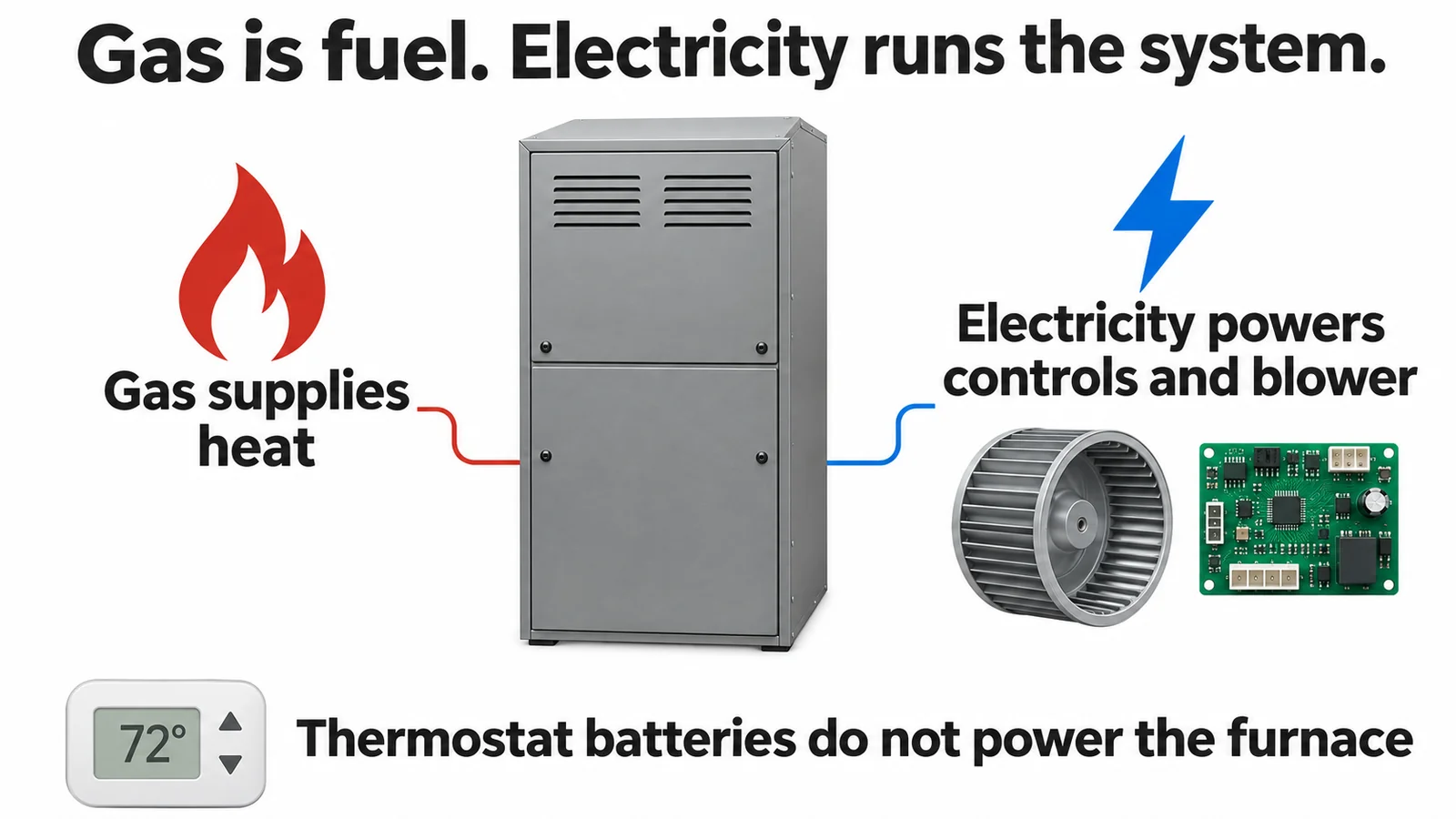
This is a concept diagram, not a wiring layout. Its displayed temperature is an illustration, not a recommended setting.
If you have a heat pump with a gas furnace, do not confuse a second fuel with a second electrical supply. Our Colorado dual-fuel guide explains normal heat-source switching; it is not an outage-power plan.
What should you do while electricity is still out?
Check your electric utility's outage reporting and updates rather than repeatedly changing furnace controls. For Xcel electric customers, the Xcel Storm Center provides reporting, restoration estimates, and an outage map. Northern Colorado has different electric providers, so use the provider serving your address, not simply the company supplying your gas.
Use layers and blankets, and plan where the household can stay warm if needed. The CDC's outage guidance recommends seeking shelter with friends or at a community shelter when conditions become too cold. Do not wait for an arbitrary number of hours before considering the needs of children, older adults, or anyone relying on powered medical equipment. Follow local emergency information and assess safe travel before relocating.
The EPA's winter guidance recommends battery-powered lighting and opening window coverings for daytime warmth, then closing them at night. It also warns against heating the house with a range, oven, or barbecue grill. A gas cooking appliance is not a substitute for your furnace.
Can you connect a generator to get the furnace running?
Do not improvise a connection during an outage. The CPSC's portable-generator safety alert specifically warns against plugging a generator into a wall outlet to energize house wiring, known as backfeeding. It can endanger utility workers and others.
If you want backup electricity for heating, discuss the actual furnace and its required connection with a qualified electrician before buying equipment. Ask what loads the proposed system supports, how it connects safely, and how operation will be verified. A generic generator or battery wattage on a shopping page is not confirmation that your installed heating system will work with it.
For portable generators, CPSC's current winter safety advice says outdoors only, at least 20 feet from the house, with exhaust directed away from the home and other occupied buildings. Never run one in a garage, even with the door open, or on a porch or in a carport. Follow the manufacturer's weather precautions and use working CO alarms with battery backup. This article is not a generator installation procedure.
What if the lights return but the heat does not?
If there is no gas odor, CO alarm, smoke, water near electrical equipment, or other hazard, look at the normal thermostat screen. Confirm the user heating mode and intended temperature using its owner's instructions. Note any displayed message and whether the furnace starts, runs briefly, or remains silent. Do not open panels to find an error code.
Follow the equipment's instructions for operation after an interruption, not a universal restart timer from another home's system. Do not repeatedly reset breakers or power-cycle the furnace to force a start. Trane's guidance warns that repeated breaker trips need a diagnosis, not repeated resets.
When requesting service, describe the sequence: power went out, power returned, and this is what the heating equipment did next. Include the thermostat message, whether the home is cooling, and whether the problem existed before the outage. That is more useful than assuming the outage damaged a specific part.
Who should you call first?
| Situation | Appropriate next contact | What to communicate |
|---|---|---|
| Gas odor, suspected gas leak, or CO alarm | Leave first; emergency responders or gas utility as described above | The warning, your location, and that you are outside |
| Electricity is still unavailable | Your electric utility | Your service address and outage status |
| Electricity is restored but heating remains unavailable | Heating service provider | Outage timing, thermostat message, and current heating behavior |
| You want future backup electricity | Qualified electrician for the power system | Exact heating equipment and the loads you want supported |
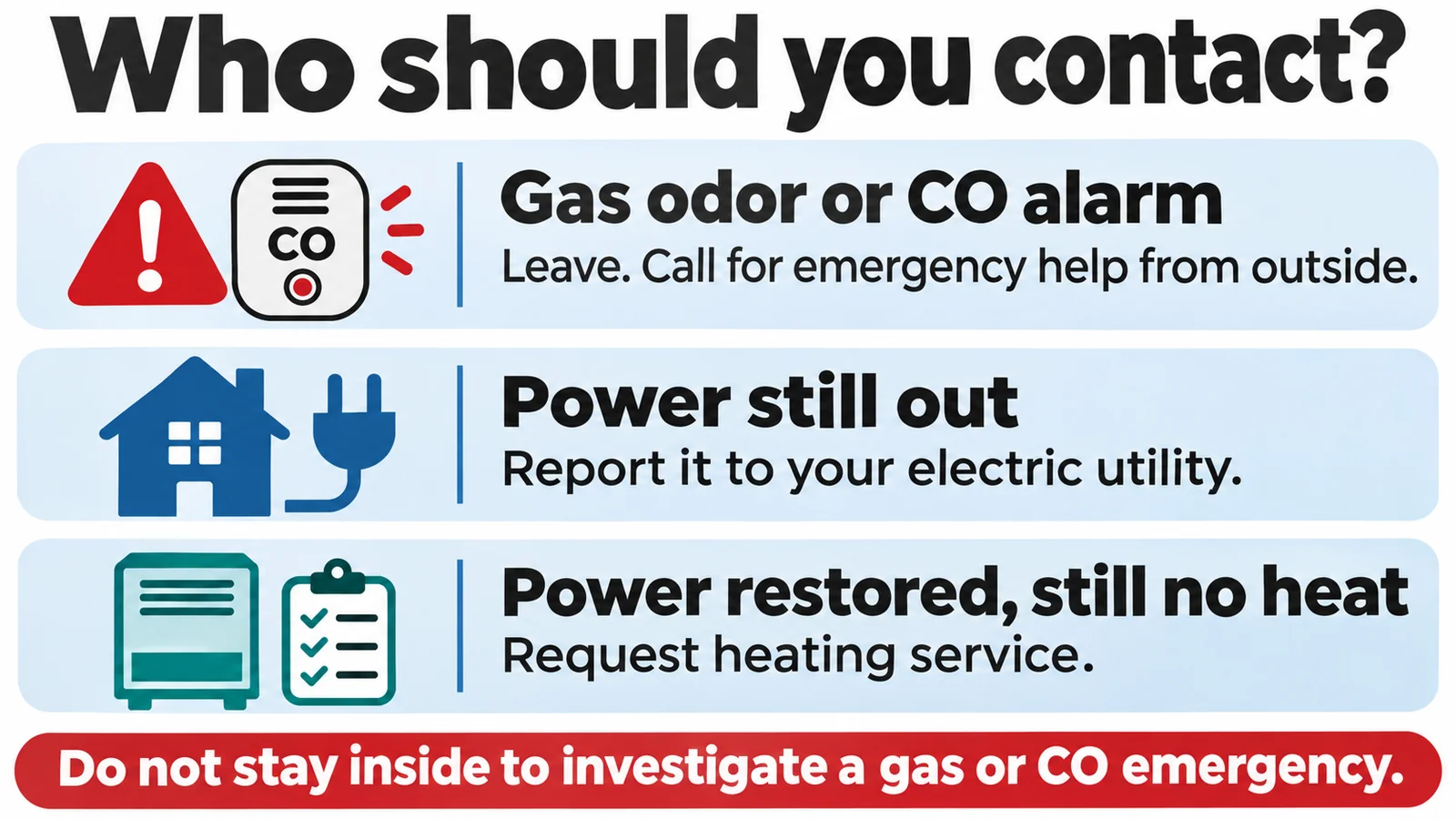
The table supplies the same routing guidance in accessible text. An emergency is not a routine service appointment.
What should you prepare before the next interruption?
Keep your utility's outage contact, furnace and thermostat manuals, heating-service number, battery lighting, and a household warm-location plan together. Check smoke and CO alarms according to their instructions. If you already own backup-power equipment, review its operating and maintenance instructions before it is needed.
The goal is not to diagnose a furnace in the dark. It is to know which problem you have, avoid unsafe substitutes, and get the right help if heating does not return.
Peak Comfort provides furnace repair and heating service across Colorado's Northern Front Range, including Boulder, Longmont, Loveland, and Fort Collins. Request help with heating that has not returned after an outage or call (720) 897-1906. For advance service planning, our furnace tune-up guide explains how to discuss the scope of a heating visit. Backup electrical-system design belongs with a qualified electrician; this is not an offer of generator installation.
The cover and both explanatory graphics are original generated illustrations, not photographs of a Peak Comfort customer home or a completed installation.
About the Author
Morgan Shaffer
Co-Owner and HVAC Specialist, Peak Comfort
Morgan specializes in high-efficiency systems, heat pumps, and field-proven HVAC solutions for Front Range weather.
References
APA style citations for sources used in this article.
- Fonda, A. (n.d.). Furnace keeps tripping breaker: Troubleshooting tips. Trane. Source
- Carrier. (n.d.). Comfort series non-programmable thermostat owner's manual: TC-NHP, TC-NAC (OM-TCNHP-05CA). Source
- City of Boulder. (n.d.). Public safety power shutoffs and related outages frequently asked questions. Source
- U.S. Environmental Protection Agency. (2026, November 10). Winter weather and indoor air quality. Source
- U.S. Consumer Product Safety Commission. (2026, January 30). Winter storms aren't over; CPSC warns of deadly carbon monoxide risks and fires during power outages. Source
- U.S. Consumer Product Safety Commission. (n.d.). Portable generator hazards (Publication 5123). Source
- Centers for Disease Control and Prevention. (2026, August 26). What to do to protect yourself during a power outage. Source
- Xcel Energy. (n.d.). Storm center. Source