
Furnace Keeps Turning On and Off? A Colorado Homeowner's Guide
Published October 8, 2026. Added to our weekly archive for the date shown above. Guidance and sources were checked at publication.
Understand furnace short cycling in Colorado, separate normal operation from repeated shutdowns, and learn the safe checks and observations that help a repair visit.
A furnace that repeatedly stops before the home reaches the thermostat setting needs attention. Check the accessible approved filter, unobstructed returns, and ordinary thermostat settings, then arrange service if the pattern continues. Do not repeatedly reset the furnace or bypass a safety control.
Short cycling describes frequent, interrupted heating cycles, but the phrase can hide several different events. A burner may shut off while the blower keeps running. The thermostat may stop asking for heat. The furnace may fail to complete ignition. Those sequences do not all point to the same repair.
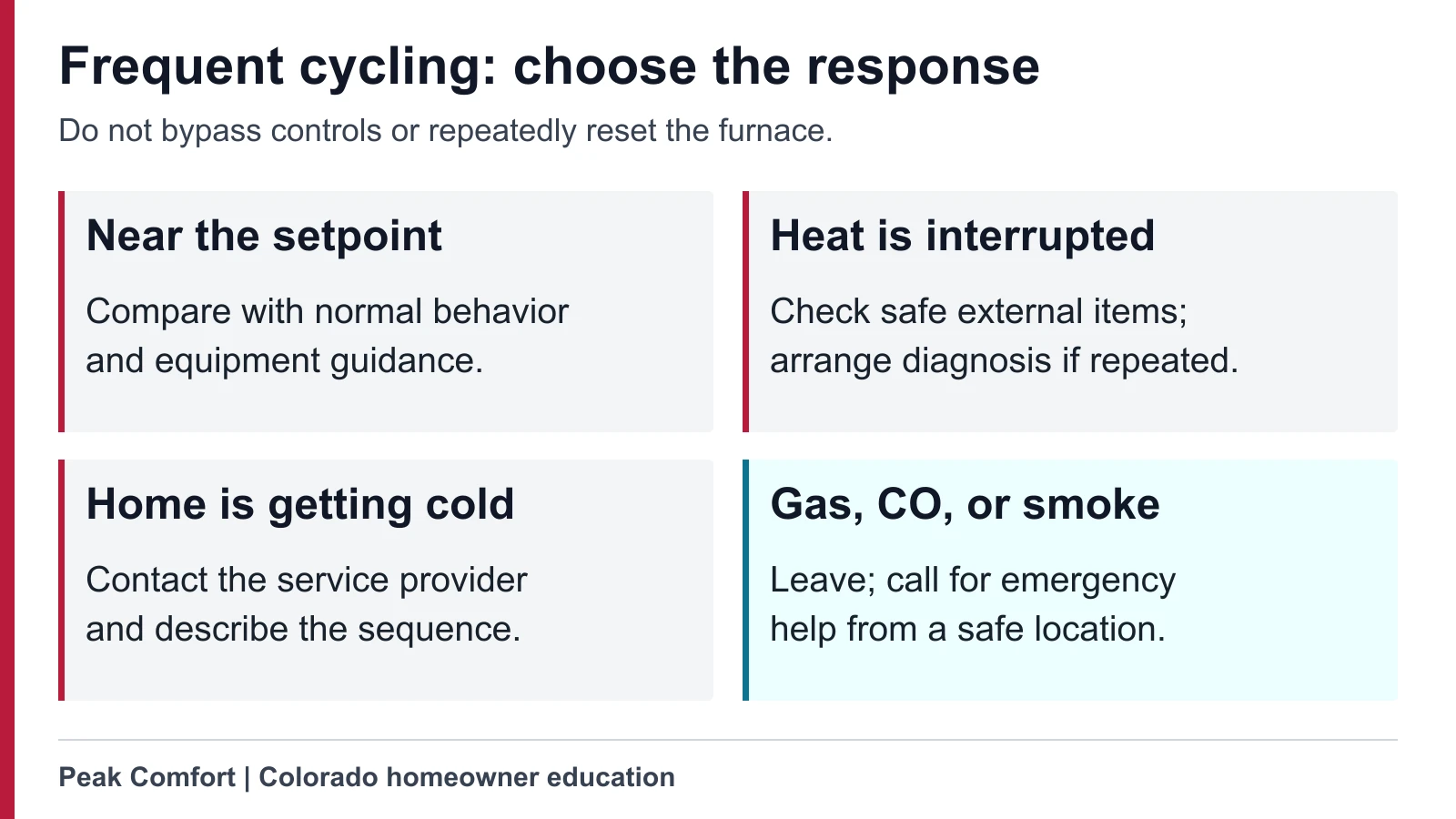
During Colorado's transition into heating season, mild afternoons and cooler mornings can change normal run times. A few short cycles near the setpoint are different from repeated shutdowns while the rooms remain cold. Start with the pattern and the indoor temperature, not a universal rule about how many minutes a furnace should run.
What counts as a useful observation?
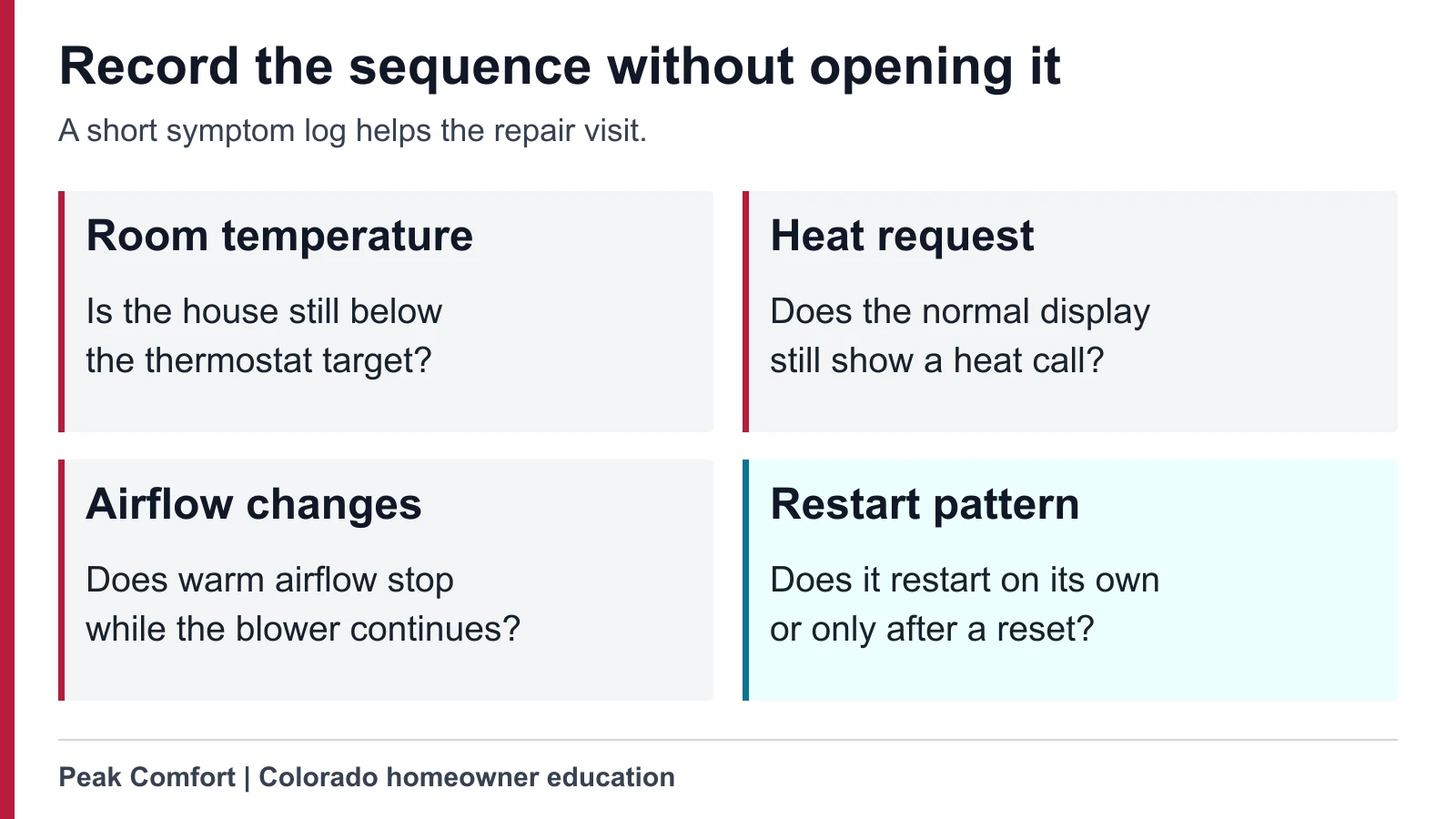
Record what you can see and hear without opening equipment. Is the room below its target? Does the thermostat still show a heat call when warm airflow stops? Does the blower continue? Does the system restart on its own or only after someone resets it?
Do not remove a service door to watch the burners or defeat a door switch. If a fault code is visible through a normal viewing window, photograph it as instructed in the owner's manual. Otherwise leave the cabinet closed.
An example note might read: "At 7 a.m., room was 64 and setpoint was 68. Warm airflow stopped before the thermostat reached 68. Blower continued. Same pattern happened again." That gives the technician more to work with than "the furnace is weird."
What are the common explanations?
Trane's short-cycling guidance identifies restricted airflow, thermostat issues, safety-control problems, and oversizing among possible causes. Those possibilities need to be distinguished, not treated as a parts-shopping list.
A restriction can be associated with overheating and a protective shutdown. A thermostat exposed to a local heat source can end a heat call before distant rooms are comfortable. An oversized furnace can satisfy the thermostat quickly. A control or ignition problem can interrupt a cycle for an entirely different reason.
The repair should follow the observed sequence and testing. Short cycling alone does not prove you need a thermostat, a limit switch, or a new furnace.
| Pattern you notice | What it helps the technician investigate | What it does not prove |
|---|---|---|
| Shutdown while the room is below target | Airflow, safety-control events, or operating faults | That a safety switch should be replaced or bypassed |
| Thermostat reaches target but other rooms stay cold | Distribution, thermostat location, or sizing | That the furnace has no fault |
| Pattern began after a filter change | Filter fit and airflow compatibility | That every high-efficiency filter causes problems |
| Furnace fails early in the starting sequence | Ignition, controls, and other model-specific causes | That cleaning one part will definitely fix it |
| Problem occurs only after repeated resets | Stored faults and interrupted operation | That another reset is a safe long-term solution |
Which checks are safe for a homeowner?
Keep the check short and external:
- Confirm the thermostat's normal heating mode, setpoint, and schedule.
- Replace user-serviceable batteries if the thermostat instructions call for them.
- Inspect the accessible filter and use the correct approved replacement if needed.
- Move furniture, rugs, or curtains away from visible returns and registers.
- Note recent filter, thermostat, renovation, or insulation changes.
- Arrange service if the pattern remains or the home is losing temperature.
Do not adjust gas pressure, clean ignition components, change installer-level control settings, or open electrical compartments. Avoid repeatedly toggling power to clear the symptom. The original fault information can be useful to the technician, and a reset does not explain the cause.
If you notice a gas smell, a CO alarm, smoke, or a burning electrical condition, stop the routine checklist and treat it as an emergency. Leave the building and call emergency services or the gas utility from a safe place. Do not stay inside to investigate.
Why can the filter matter to both heating and cooling?
In many ducted homes, the furnace blower also moves air during cooling. A filter change late in AC season can therefore become part of the history when heating starts. That is a reason to record specifications, not assume the filter is responsible.
Have the technician evaluate the actual filter, rack, blower configuration, and duct path. A filter can be the correct printed size but fit poorly; a different product may change resistance. Ask how any airflow conclusion was confirmed.
For a smoke-season upgrade, our Colorado smoke-filtration guide explains why particle capture and airflow compatibility need separate checks. If summer cooling also froze, mention that history during the heating visit.
Does Colorado's shoulder season make short cycling normal?
Heating demand changes with weather, sun exposure, and the house. Equipment behavior can also differ between single-stage, staged, and modulating systems. That makes a fixed run-time rule unreliable.
What should not be ignored is a change from the system's normal behavior, repeated shutdown before target temperature, or a home that continues getting colder. Tell the technician whether the problem existed last winter and whether it started after another change.
Do not assume altitude explains every operating issue. If setup or installation requirements are in question, the contractor should use the exact furnace model's guidance and the installation location.
What should a diagnostic visit produce?
Ask for the fault or operating concern that was confirmed, the evidence behind it, and how the proposed repair will be checked. Carrier's furnace-service guidance includes operating performance, controls, airflow-related components, and venting among relevant service areas.
If the explanation is simply "it is old," ask what is failing. If the recommendation is a larger furnace, ask how that follows from the diagnosis. Oversizing and distribution concerns are reasons to evaluate the load, not automatically add heating capacity.
If replacement becomes appropriate, review our Colorado sizing guide and repair-or-replace discussion. A documented diagnosis should remain part of the decision.
Questions about a furnace turning on and off
Is a blower running after the burner stops always a problem?
No. Some blower operation after a heating cycle can be part of the normal sequence. The important questions are whether the heat call ended normally and whether the home is reaching its target.
Should I keep resetting it until a technician arrives?
Do not use repeated resets as a workaround. Follow any safety or operating instruction from the service provider and explain the original pattern when scheduling.
Can I diagnose a bad limit switch from short cycling?
No. A safety control can respond correctly to another problem, or have a fault itself. A qualified technician needs to distinguish those situations before recommending a repair.
Do working CO alarms mean the furnace is safe to keep running?
Alarms are essential protection but do not replace equipment servicing or resolve an operating fault. Follow CPSC's CO guidance, and never ignore an alarm or emergency symptom.
Give the repair visit a better starting point
Record the sequence, do the safe external checks, and stop guessing at parts. A useful repair addresses the reason heat is being interrupted and confirms the system's operation afterward.
Peak Comfort provides furnace repair and heating service for Colorado's Northern Front Range. Request a diagnostic appointment and tell us whether the room stays below target, whether the blower continues, and whether you have reset the equipment.
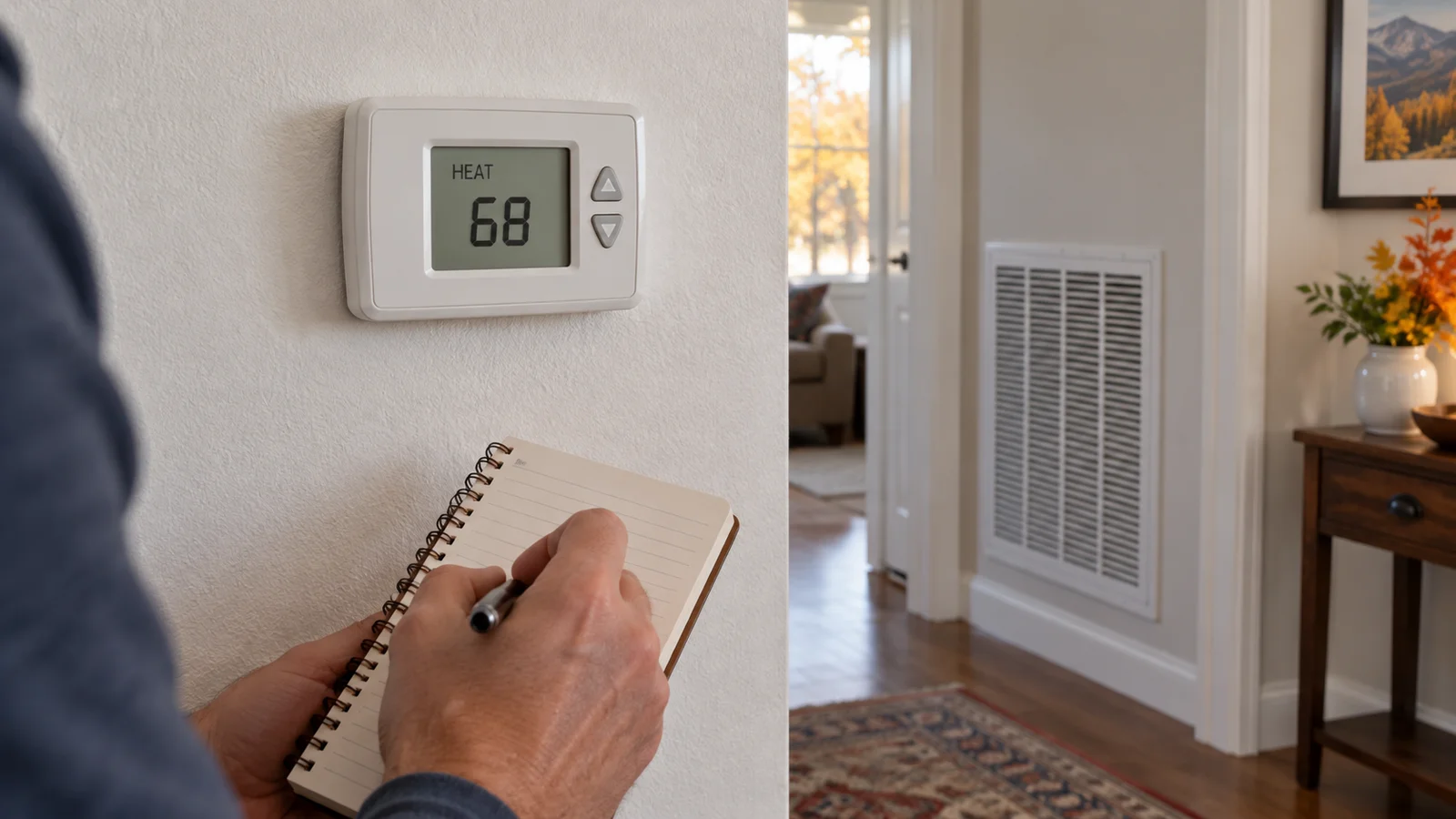
The cover is an original generated illustration. The graphics explain observations and response choices, not a diagnosis of your equipment.
About the Author
Morgan Shaffer
Co-Owner and HVAC Specialist, Peak Comfort
Morgan specializes in high-efficiency systems, heat pumps, and field-proven HVAC solutions for Front Range weather.
References
APA style citations for sources used in this article.