
Should You Lower Your Heat Pump Thermostat at Night in Colorado?
Compare steady heat-pump settings and nighttime setbacks in Colorado. Learn how morning recovery, AUX heat, and compatible controls affect the right approach.
Do not assume a large overnight thermostat setback is the best strategy for a Colorado heat pump. A steady, comfortable setting is a sensible starting point, especially with electric backup heat. A compatible thermostat with adaptive recovery may support scheduled setbacks, but the appropriate amount and timing depend on the installed system. Keep backup protection enabled and ask how your controls handle morning recovery.
For Northern Front Range homeowners heading into regular winter heating, this is a different question from whether a heat pump can handle the weather. A system can heat the house well and still have a schedule that deserves review. If you recently replaced a furnace-and-AC setup, do not automatically carry its old overnight schedule into the new equipment.
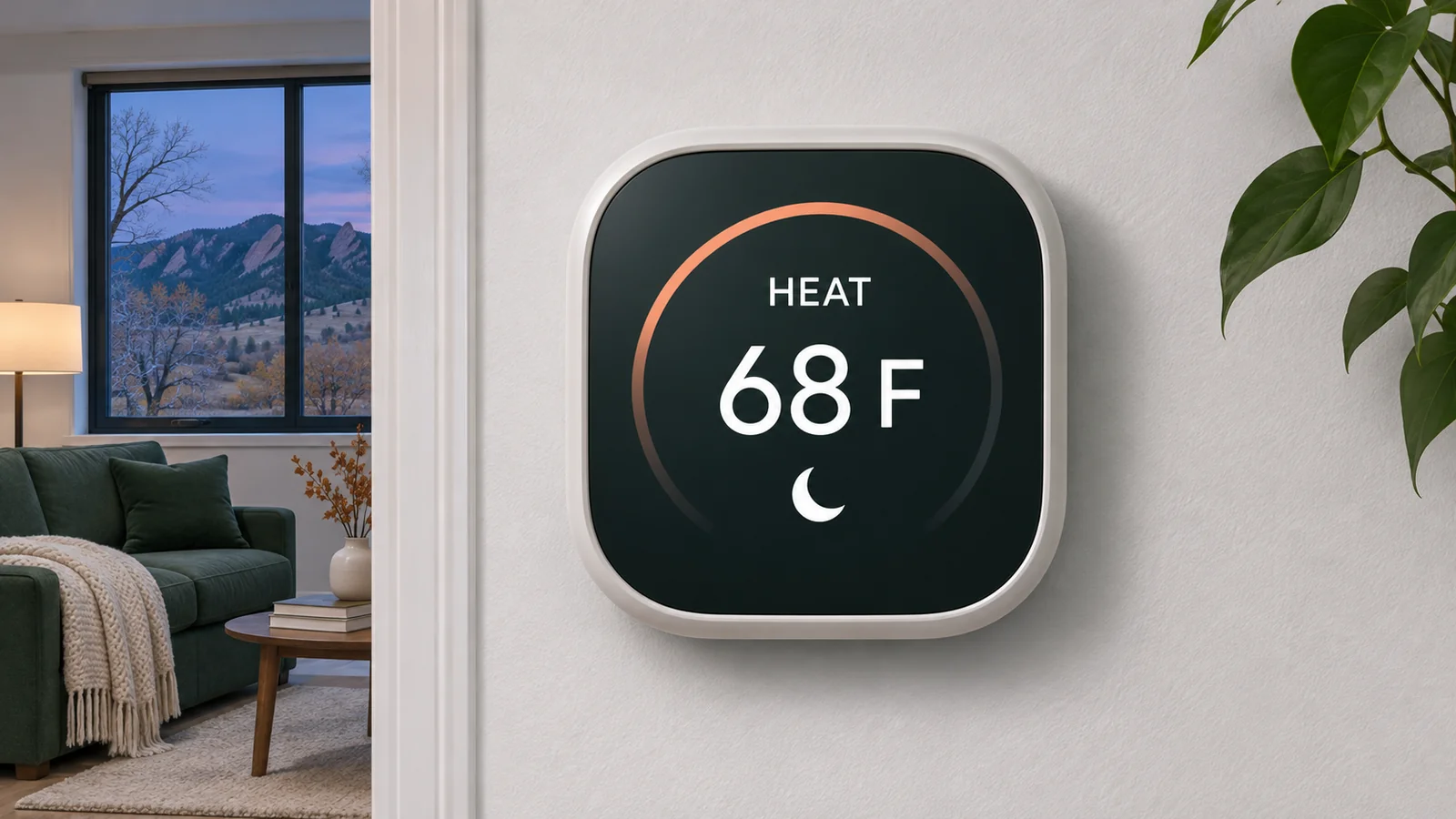
This guide focuses on ordinary homeowner temperature schedules, not installer-level staging or lockout settings. The cover's displayed temperature is an illustrative example, not a recommendation for every household.
What are setback and recovery?
A setback lowers the desired indoor temperature for a period, such as overnight or while the home is empty. Recovery is the process of bringing the house back to the desired occupied temperature afterward.
Those are two parts of the same schedule. The decision is not only how cool the house becomes while you sleep, but how the equipment responds when the target rises again.
PNNL's thermostat guidance explains that adaptive recovery can start heating before the scheduled comfort time, allowing a more gradual return and reducing reliance on electric resistance backup. The feature must be appropriate to the system; the word "programmable" alone does not explain how recovery works.
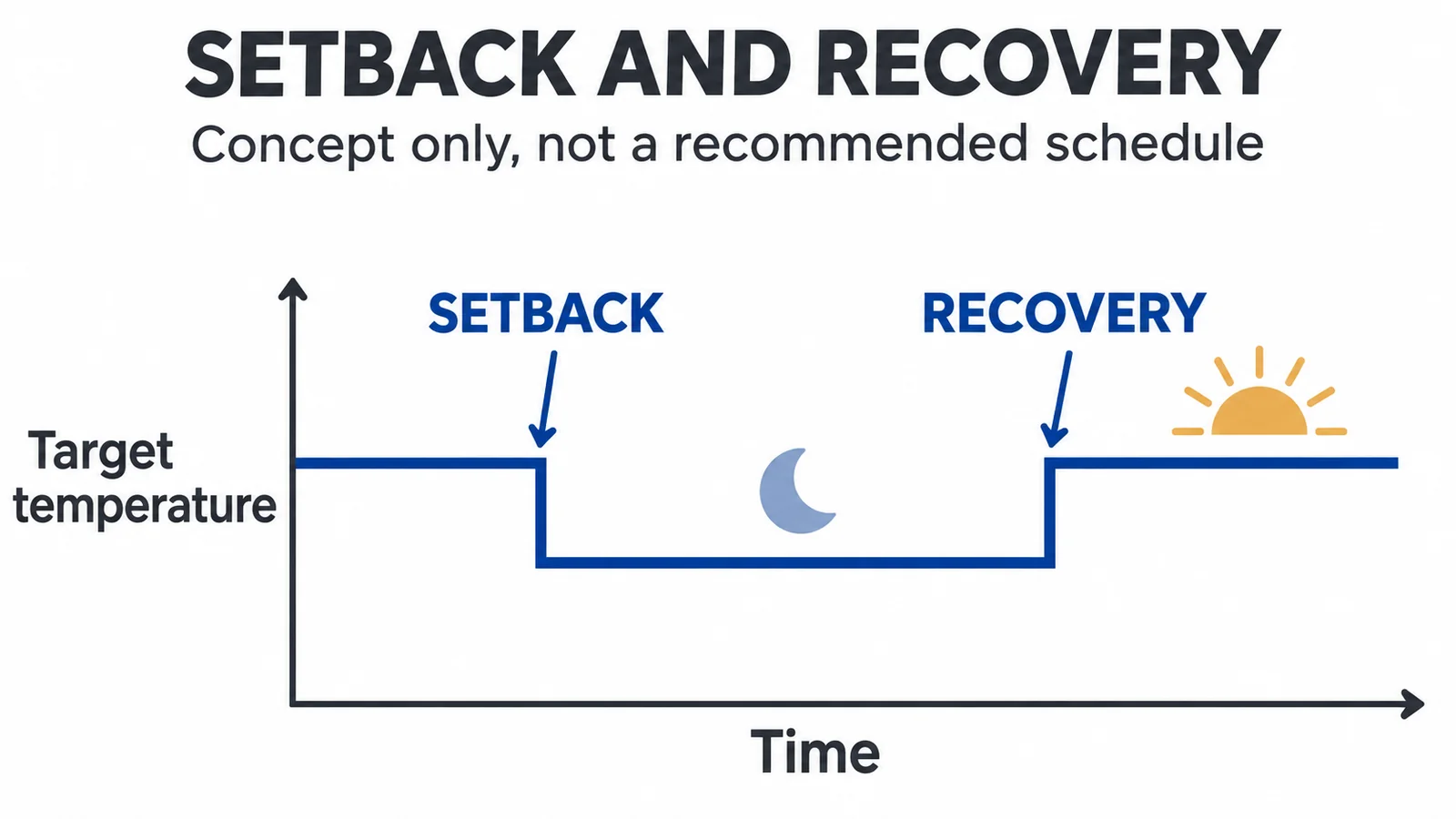
This diagram defines the terms. It shows target settings, not measured room temperature, energy consumption, a recovery-time prediction, or a recommended schedule.
Why can a big morning temperature jump call for backup heat?
Heat-pump controls can respond to the gap between room temperature and the new target, as well as other operating conditions. Raising the target substantially can request more heat than simply maintaining the previous setting.
Carrier's auxiliary-heat guide identifies rapid setpoint increases as one situation in which backup heat may be called. It also makes clear that there is no universal outdoor temperature at which every system activates backup.
That does not mean every morning AUX indication proves wasted energy or broken equipment. It means the recovery sequence belongs in the conversation. Tell the contractor whether the indication appears just after a scheduled increase, during ordinary steady heating, or alongside a failure to reach the target.
Do not disable backup heat to make the label disappear. It may be needed for the installed system's intended operation. Ask what the control is doing and why before changing its configuration.
Is keeping one temperature always better than using a schedule?
Not always. The controls, equipment, home, and household routine matter. Carrier's thermostat guide cautions against large nighttime drops and discusses steady settings or modest setbacks with suitable controls.
Use the following comparison to frame a conversation, not to calculate savings:
| Approach | Why consider it? | What needs verification? |
|---|---|---|
| Steady comfortable setting | A straightforward starting point when recovery behavior is unclear | Comfort through the night and normal system operation |
| Modest scheduled setback | May suit a household that prefers a cooler sleeping period | Compatibility, recovery behavior, and the installer-recommended schedule |
| Larger setback with abrupt morning increase | Creates a bigger change for the system to recover | Whether the control calls backup and whether this strategy suits the installation |
| Adaptive recovery | Can begin warming before the requested comfort time | The feature's actual operation and configuration on your equipment |
There is no single number of degrees that this table approves for every Colorado home. A useful recommendation should identify the system and the household goal instead of quoting a universal rule. Do not lower the setting below what occupants or the home require merely to follow a generic efficiency tip.
Does a smart thermostat automatically solve the problem?
No. Remote access and recovery logic are different capabilities. ENERGY STAR's buying guidance says to confirm compatibility with the heating and cooling equipment; some high-efficiency equipment may benefit from its manufacturer's controller.
Before purchasing a replacement, ask these specific questions:
- Does the installed control support this heat pump and its backup arrangement?
- Does it have adaptive or smart recovery, and is that feature enabled as intended?
- Is the schedule time when heating should begin, or when the room should reach its target?
- Can automatic occupancy settings or a temporary hold override the overnight schedule?
- What operating history can you view without changing installer settings?
Keep the exact model numbers available. Buying a thermostat because it has Wi-Fi, an attractive screen, or a learning feature does not establish that it is the right replacement for the existing control. Leave wiring and equipment configuration to qualified service personnel.
What is the difference between HEAT, AUX, and Emergency Heat?
On many conventional heat-pump controls, HEAT is the normal operating mode. AUX indicates an automatically selected backup stage. Emergency Heat is a separate manual mode that can bypass the outdoor compressor and rely on backup.
Carrier distinguishes automatic auxiliary operation from manual Emergency Heat. Do not use Emergency Heat as a routine shortcut for a chilly morning. If the heat pump is malfunctioning, follow the model's instructions and contact your service provider about the appropriate temporary operation.
Labels and sequences vary. A dual-fuel installation may have a gas furnace as backup rather than electric resistance heat, and the approved sequence must determine how sources operate. Our Colorado dual-fuel guide addresses source selection and operating-cost assumptions separately from an overnight schedule.
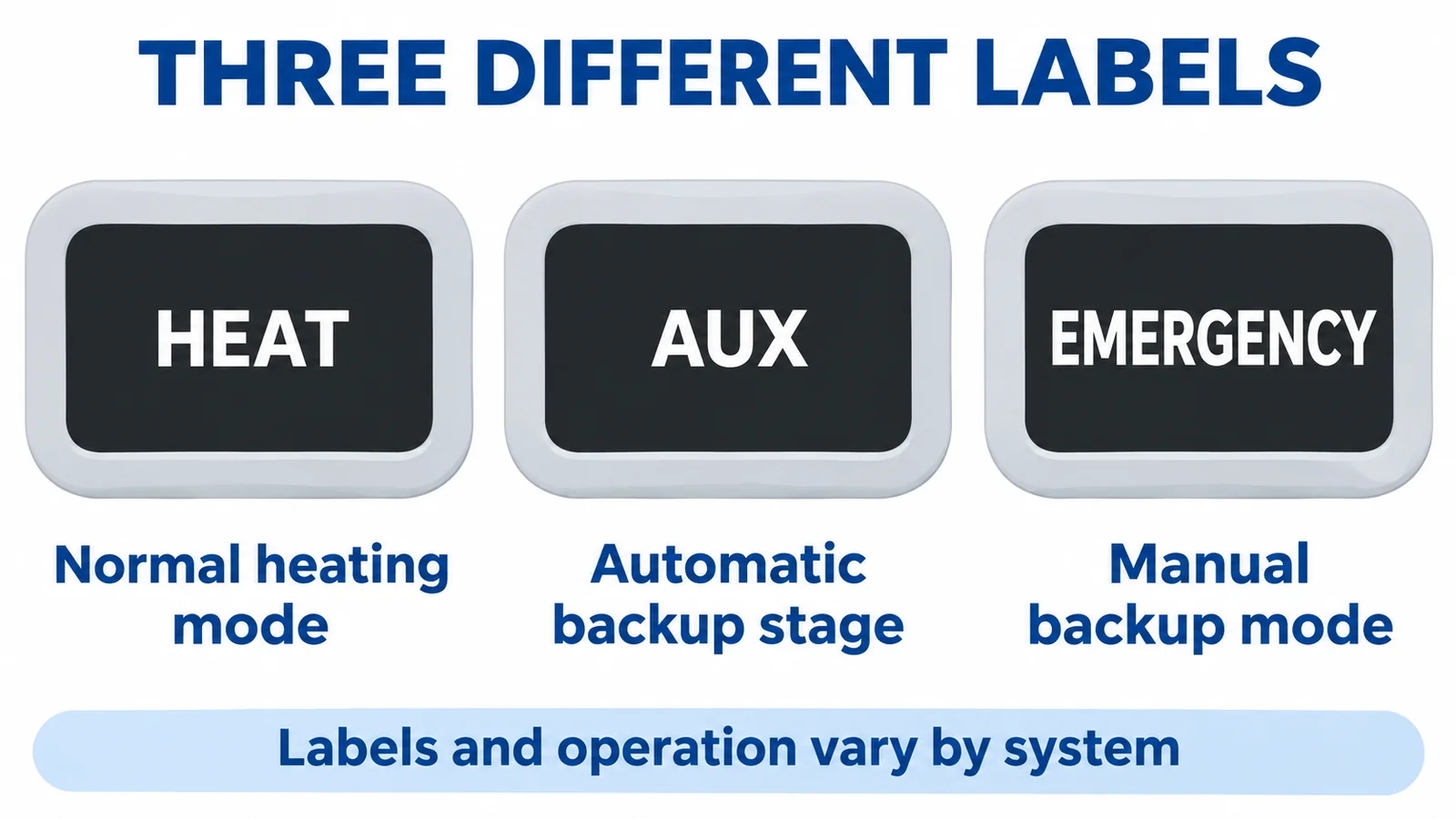
These are explanatory labels, not screenshots or instructions for selecting a mode on your thermostat. The distinctions above are also available as text.
What should you record before asking for a schedule review?
For a Longmont, Boulder, Loveland, or Fort Collins home, bring a short account of what happens overnight and in the morning:
- The thermostat and heat-pump model, plus the known backup type.
- The ordinary night and morning targets and scheduled times.
- Whether a hold, away setting, or occupancy feature was active.
- The actual room temperature when recovery began and when comfort returned.
- Any visible backup indication, fault message, or unusually cold rooms.
Use normal displays or available operating history. Do not open cabinets, alter wiring, or experiment with installer menus to obtain more data. If you do not know the backup type, say so rather than guessing from the thermostat label.
A single bill cannot isolate the effect of a schedule. Weather, rates, occupancy, and other changes can affect the comparison. This article does not predict a percentage saving or a monthly dollar benefit.
What if the house is not warming up at all?
A schedule review is not a substitute for diagnosing a heating fault. Contact the service provider if the house keeps losing temperature, the system reports a fault, or normal recovery is not occurring. Do not keep raising the target to force a result.
If persistent outdoor ice is involved, see our heat-pump defrost and service guide. If only one room is cold while the rest of the house reaches its setting, our uneven-heating guide explains a different assessment. Those symptoms should not all be attributed to a nighttime schedule.
Start with the controls you have
Keep a comfortable baseline, understand how recovery is handled, and confirm the intended schedule before making large overnight changes. A clear explanation of the installed system is more useful than a fixed "always set back" or "never set back" rule.
Peak Comfort provides heat-pump installation and service across Colorado's Northern Front Range. Request a heat-pump controls review to discuss the equipment, backup arrangement, and overnight comfort goals for your home.
All three images are original generated illustrations. They do not depict a verified customer home, measured performance, a specific product interface, or guaranteed savings.
About the Author
Morgan Shaffer
Co-Owner and HVAC Specialist, Peak Comfort
Morgan specializes in high-efficiency systems, heat pumps, and field-proven HVAC solutions for Front Range weather.
References
APA style citations for sources used in this article.
- Pacific Northwest National Laboratory. (2017, October 5). Thermostat controls. Building America Solution Center. Source
- Mayes, R. (n.d.). Heat pump thermostat guide: How they work, features, settings. Carrier. Source
- Baugh, T. (2026, October 28). What is auxiliary heat? Carrier. Source
- ENERGY STAR. (n.d.). Smart thermostats. Source