
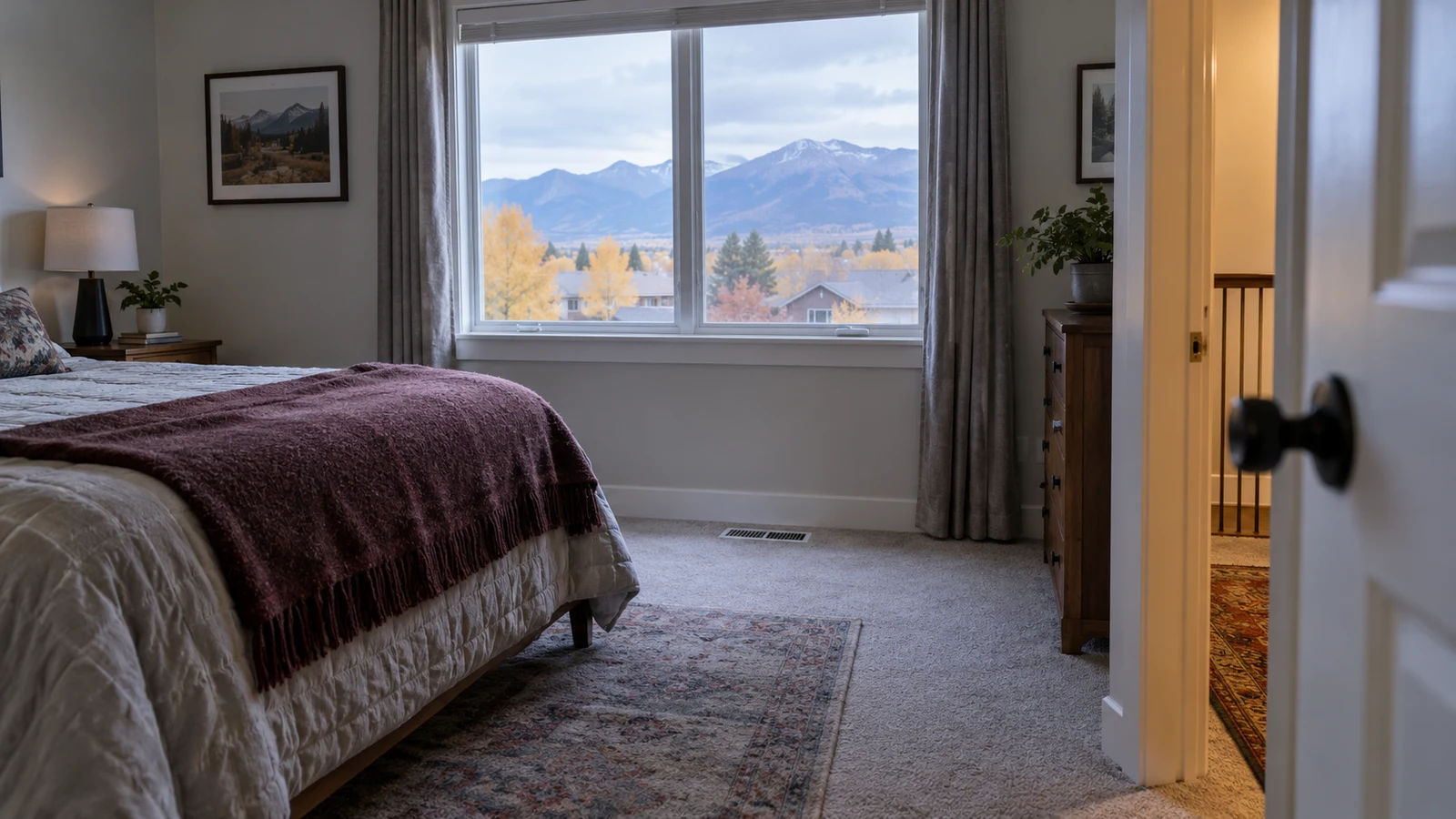
Why Is One Room Colder Than the Rest of My Colorado Home?
One cold room does not automatically mean a bad furnace. Learn safe airflow checks, door and duct clues, and when Colorado homes need a comfort assessment.
If one room is cold while the rest of your Colorado home heats normally, start with that room's air supply, return path, and heat loss, not a larger furnace. Clear blocked registers, note whether the problem changes with the door position, and document the pattern before arranging an HVAC assessment. A room can have more than one contributing problem.
October is a useful time to investigate a bedroom that never quite warms up. The National Weather Service's Denver climate record lists October 7 as the average first-freeze date. That is historical context, not a forecast for your address, but it explains why a comfort issue can become more noticeable as Front Range homes return to regular heating.
Whether you live in Longmont, Boulder, Loveland, or Fort Collins, a room-by-room complaint deserves a room-by-room explanation. This guide focuses on homes with a central forced-air furnace or ducted heat pump. Boiler, baseboard, and ductless systems need different checks.
Is the problem one cold room or the whole house losing heat?
First, separate two situations. If most rooms reach their normal temperature but one bedroom or office stays cold, the distribution system and that room's construction deserve attention. If the entire house is falling behind, or the equipment repeatedly shuts down before reaching the thermostat target, schedule heating service rather than treating it as an isolated room problem.
You do not need to diagnose the furnace to make that distinction. Note which rooms are affected, whether the thermostat reaches its setting, and whether this is a longstanding issue or a sudden change.
For interrupted heating cycles, see our Colorado furnace short-cycling guide. For a heat pump with persistent outdoor ice and declining indoor temperature, use the defrost and repair guide.
If you smell gas, leave and contact your gas utility or emergency services from a safe location. For smoke or a sounding carbon monoxide alarm, get outside and call emergency services. CPSC's CO guidance says not to reenter after an alarm until responders give permission. Do not continue a comfort checklist during an emergency.
What can make a single room colder?
Think about three separate jobs: getting heated air into the room, letting air return to the system, and limiting heat loss through the room's boundaries.
| Possible issue | Clue worth recording | What needs verification |
|---|---|---|
| Restricted supply airflow | Furniture over a register, weak delivery, or a sudden change | Register condition, duct path, and delivered airflow |
| Limited return-air path | The complaint changes when the bedroom door is closed | Pressure balance and the intended return route |
| Duct leakage or damage | An addition or distant room has always struggled | Duct connections, restrictions, leakage, and insulation |
| Greater room heat loss | A cold floor, exterior exposure, or discomfort during windy weather | Air leakage and insulation at the affected boundaries |
| Control or zoning issue | Comfort changed after thermostat or zone-control work | Sensor selection, settings, and approved equipment operation |
The clues help direct the investigation; they do not prove a cause. Feeling warm air at a register, for example, does not establish that enough air reaches the room over a heating cycle.
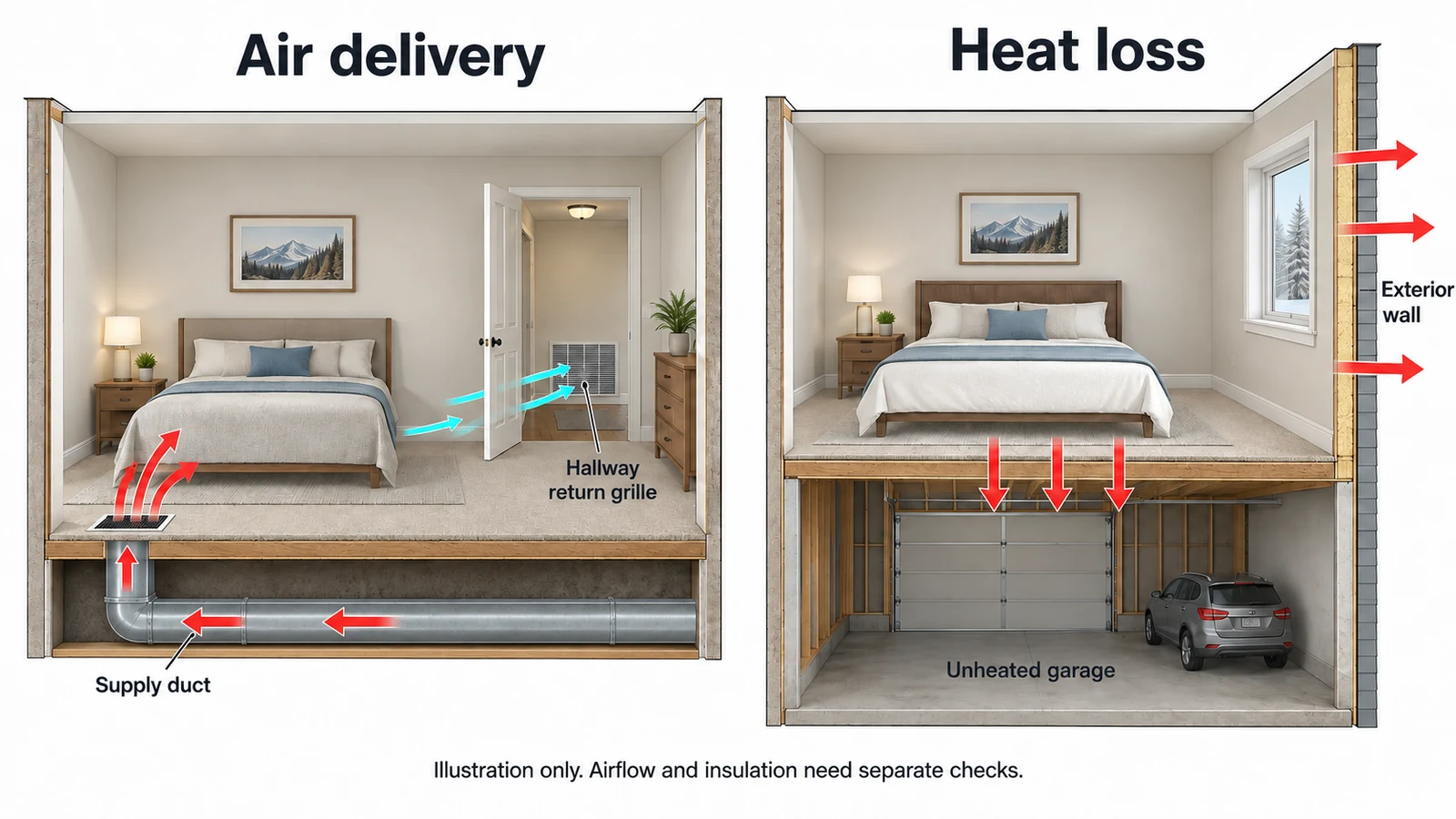
Air delivery and heat loss are different questions. This original illustration shows general relationships, not measured conditions or a construction detail for your home.
Why can a closed bedroom door affect heating?
Supply air entering a bedroom needs a route back toward the air handler. Some homes have dedicated room returns; others rely on a designed pathway to a central return.
PNNL's bedroom pressure-balancing guidance explains how a closed door can restrict that route and contribute to room pressure and temperature differences. A small gap under the door is not proof that the return pathway is adequate.
Record the usual door position when the room is uncomfortable, and tell the contractor if the pattern changes when it is open. That is an observation, not a reason to change a family's nighttime door routine or cut an opening yourself. A professional can evaluate options appropriate to the house and its safety requirements.
Do not block a return grille to keep more heat in the room. It is part of the air-circulation path, not a hole that simply lets heat escape outdoors.
Which homeowner checks are worth doing first?
Keep these checks external and follow your equipment's instructions:
- Clear the room's registers. Move rugs, furniture, or curtains that cover visible supply or return openings. Note accessible register settings without changing hidden dampers or motorized zone controls.
- Check the approved, accessible filter. If it needs replacement, use the specified type and size. Do not remove it as an ongoing airflow workaround.
- Confirm ordinary thermostat settings. Look at heating mode, schedule, and any room-sensor selection you normally use. Record recent changes rather than experimenting with installer settings.
- Compare room temperatures consistently. If you use portable thermometers, first place them together to check that they agree reasonably. Then keep them away from direct sun, registers, and exterior surfaces, following their instructions.
- Keep a short pattern log. Note time, weather, room temperature, thermostat reading, door position, and whether normal heating is operating. Include whether the room also becomes uncomfortable in summer.
This gives a service visit a useful starting point without opening equipment or promising a do-it-yourself repair. A hand over a vent and a single temperature reading cannot establish a design airflow or heat-loss requirement.
Should you close other vents to send more heat to the cold room?
Do not use widespread vent closure as a substitute for system balancing. Carrier's furnace guidance identifies closed supply vents and blocked returns as potential airflow restrictions that can contribute to furnace overheating and protective shutdowns.
Professional balancing is different from randomly closing registers. It considers the equipment's airflow needs and delivery to the other rooms, then verifies the result. Do not reset every damper you find to the same position; an existing setting may be part of a designed system.
Likewise, raising the thermostat repeatedly may make the comfortable rooms warmer without resolving the cold room's underlying problem. Use the temperature difference and operating history to guide an assessment instead.
Why does a room over a garage need more than an airflow check?
A room can receive heated air and still lose heat through a poorly performing floor, wall, ceiling, or window boundary. An upstairs bedroom over an unheated garage is a useful example: the space below is not another heated living room.
ENERGY STAR's comfort-problem guide associates uneven temperatures and cold floors with insulation, air leakage, and duct issues. Distinguishing those categories matters before approving equipment work.
Ask whether an HVAC assessment, a home energy assessment, or coordinated work is needed. Do not assume the HVAC contractor's visit includes an insulation or building-envelope investigation. Ask about that scope explicitly.
Do not drill through a garage ceiling, remove protective assemblies, or seal combustion-air openings based on a blog. Building boundaries, ventilation, and combustion safety need qualified review. ENERGY STAR also warns that air sealing can affect combustion appliances and indoor air quality.
What should a professional comfort assessment explain?
Ask for a finding tied to the cold room, not just a recommendation for different equipment. ENERGY STAR's contractor guidance calls for evaluating supply and return balance, inspecting duct condition, and checking airflow after repairs.
A useful conversation covers:
- What was observed or measured at the affected room.
- Whether the supply and return pathways are appropriate.
- Whether accessible ducts show damage, restrictions, or leakage.
- Which findings involve the HVAC system and which require another qualified trade.
- What work is proposed, what it excludes, and how the result will be checked.
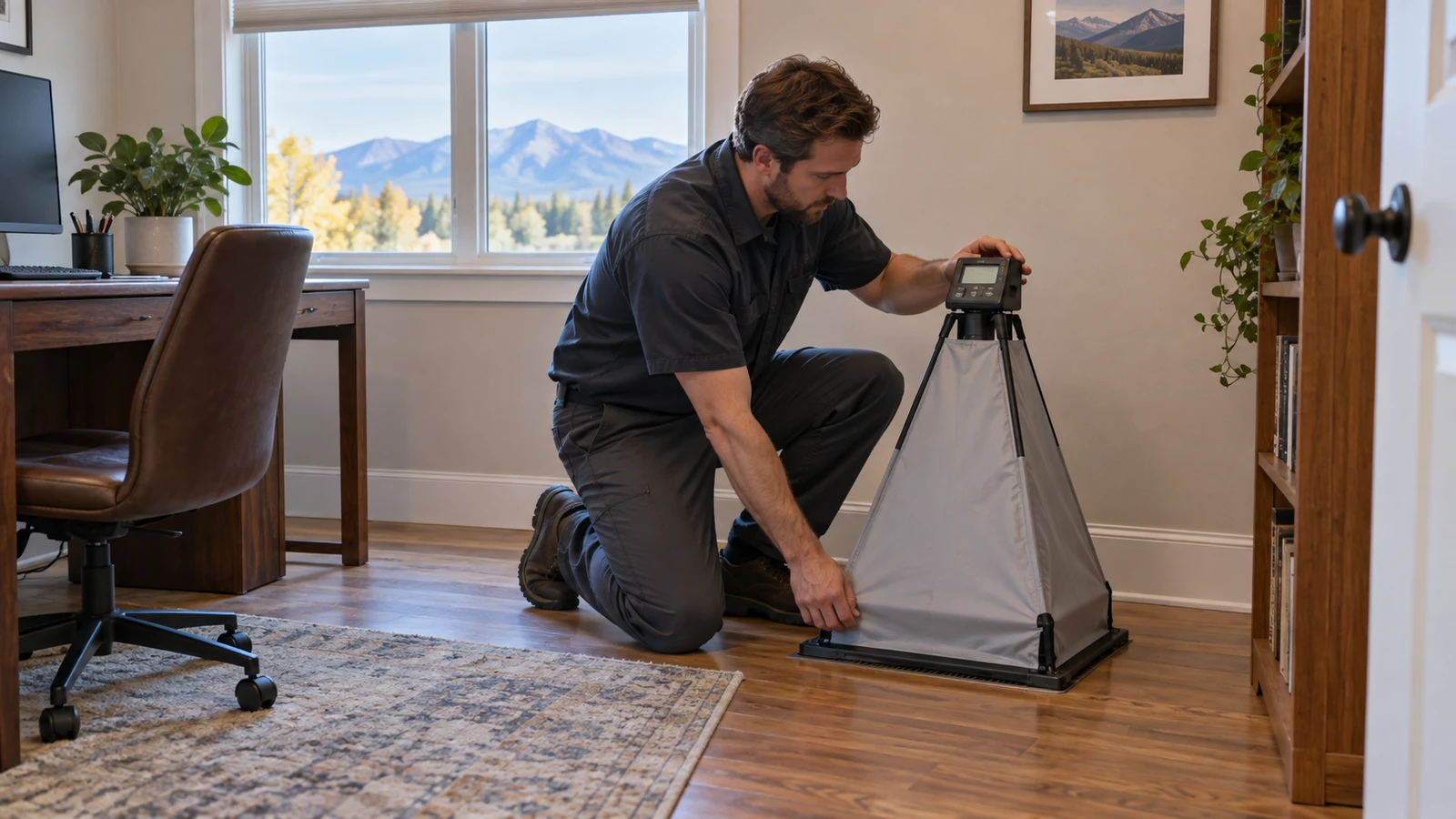
Illustrative airflow measurement, not a photograph of a Peak Comfort customer appointment. The appropriate test depends on the system and the question being investigated.
If a replacement is proposed, ask how it addresses this room's complaint. Our Colorado HVAC sizing guide explains the role of room-by-room loads and duct capacity. A larger furnace is not an automatic cure for an air-delivery or insulation problem.
Would a mini split or zoning solve it?
They can be options for a suitable application, but neither should replace understanding the cause. Compare the complete scope and the remaining building or duct issues before choosing a solution.
For example, an addition that is difficult to serve with existing ducts presents a different decision from a bedroom with a blocked register. Our ducted-versus-ductless comparison covers that equipment choice after the room's needs are understood.
Questions about cold rooms in Colorado homes
Does one cold bedroom mean the furnace is too small?
Not by itself. Equipment capacity, room air delivery, return pathways, controls, and room heat loss are separate checks. A whole-house heating problem should also be distinguished from a single-room complaint.
Can a smart thermostat fix uneven heating?
A room sensor or control change can affect where temperature is measured and how the system responds. It does not repair a disconnected duct or add missing insulation. Ask which specific problem the control change is intended to solve.
Should I buy a register booster fan first?
Identify the cause before buying accessories. A booster does not repair duct leakage, establish an adequate return path, or resolve building heat loss. Ask whether it is suitable for the installation and what evidence supports using it.
What if the problem started after a remodel?
Tell the contractor which rooms, registers, walls, doors, controls, or uses changed. Keep that history with your temperature observations. A remodel can change the conditions the original system was designed to serve.
Start with the room, then choose the work
Clear obvious obstructions, document the pattern, and get an explanation that separates air delivery from heat loss. That approach gives you a better basis for a repair, comfort improvement, or replacement decision.
Peak Comfort provides heating service and HVAC services throughout Colorado's Northern Front Range. Request help with an uneven-heating problem and tell us which room is cold, when it happens, and whether the rest of the house reaches its normal temperature.
All three images are original generated illustrations. They explain the article's subject and do not depict a verified customer home, test result, or installation.
About the Author
Morgan Shaffer
Co-Owner and HVAC Specialist, Peak Comfort
Morgan specializes in high-efficiency systems, heat pumps, and field-proven HVAC solutions for Front Range weather.
References
APA style citations for sources used in this article.
- ENERGY STAR. (n.d.). Duct sealing. Source
- Pacific Northwest National Laboratory. (n.d.). Pressure balancing bedrooms. Building America Solution Center. Source
- ENERGY STAR. (n.d.). Identify the problems you want to fix. Source
- ENERGY STAR. (n.d.). Hire a professional contractor for duct improvement projects. Source
- Mayes, R. (n.d.). Reasons your furnace is blowing cold air and how to fix them. Carrier. Source
- National Weather Service, Denver/Boulder. (n.d.). Denver's fall/winter/spring statistics. Source
- U.S. Consumer Product Safety Commission. (n.d.). Carbon monoxide fact sheet. Source