
Xcel Heat Pump Rebates in Colorado After October 1, 2026
Updated October 12, 2026.
Compare Xcel's Colorado heat pump rebates effective October 1, 2026, including standard and bonus totals, equipment eligibility, and installation planning.
Xcel's Colorado heat pump rebate change took effect October 1, 2026. For qualifying cold-climate air-source systems, the current standard rebate is $750 per heating ton at 5 F; the eligible total including bonus is $1,500 per heating ton at 5 F. The $1,500 is a total, not an extra payment on top of the standard rebate.
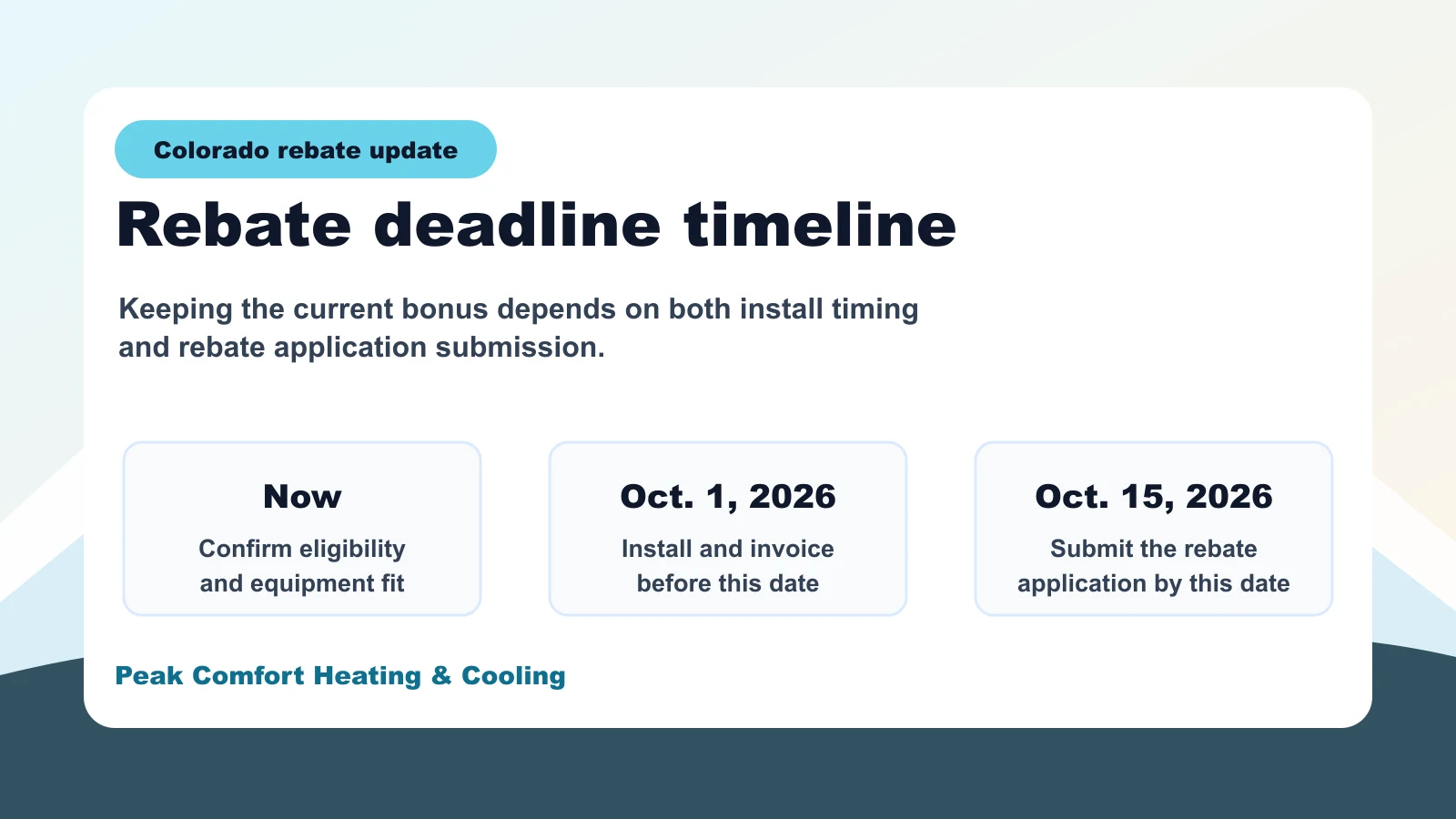
This article was originally published before the change. It has been updated against Xcel's current residential rebate summary, effective October 1, 2026. A new installation cannot meet the past October 1 installation cutoff. Plan around the current rules, not the earlier promotion.
For Boulder, Longmont, Loveland, and Fort Collins homeowners, the first question is which utility serves your address and what fuel currently heats the home. Living on the Front Range does not automatically make you an eligible Xcel customer. Request a heat pump and rebate assessment before using an incentive amount in your budget.
What are Xcel's current Colorado heat pump rebate amounts?
The following amounts are from the current residential summary. Equipment, customer service, installation, invoice, and application requirements still apply.
| Equipment | Standard rebate | Eligible total including bonus |
|---|---|---|
| Cold-climate air-source heat pump, ducted or mixed ducted | $750 per heating ton at 5 F | $1,500 per heating ton at 5 F |
| Standard air-source heat pump, ducted or mixed ducted | $300 per cooling ton at 95 F | $600 per cooling ton at 95 F |
| Ground-source heat pump | $1,100 per heating ton | $2,200 per heating ton |
| Heat pump water heater | $750 | $1,500 |
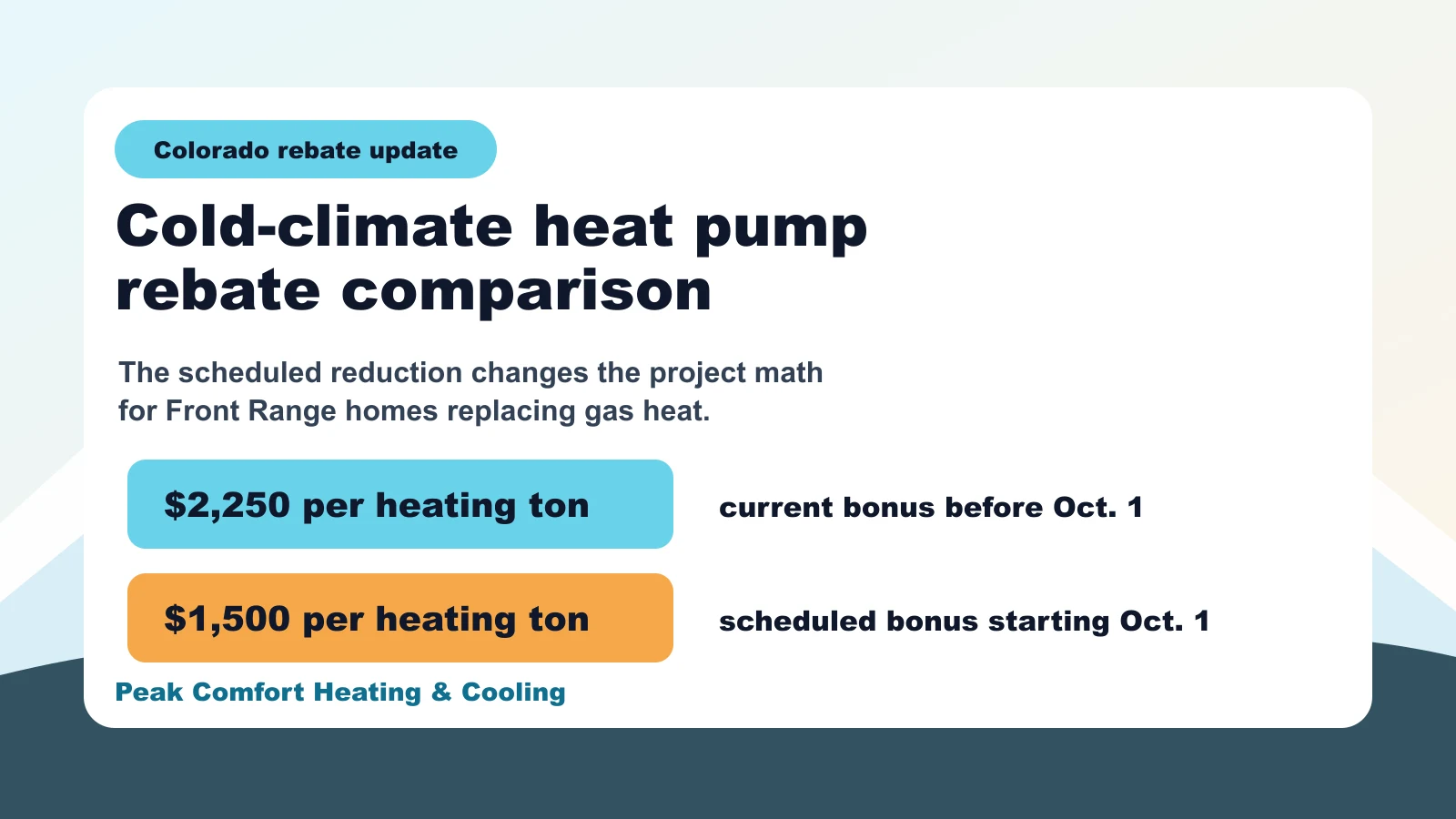
The former August article discussed a $2,250-per-heating-ton cold-climate offer. That is historical context, not the amount to assume for a new October installation. The current table distinguishes the base rebate from the total available when the bonus applies.
The heating-ton basis matters. Do not multiply the outdoor unit's advertised cooling size by the cold-climate rate and assume that is your payment. Ask for the qualifying matched system's heating output at 5 F and the program calculation on your proposal.
Who can receive the bonus instead of just the standard rebate?
Xcel's heat pump page identifies natural-gas-heating customers as a potential bonus group. Its summary excludes the bonus for customers whose existing primary heating system is electric. Those customers may still qualify for a standard rebate, subject to the service and equipment rules.
Do not assume that having an Xcel bill, or switching one appliance, settles eligibility. Have the contractor verify your electric and gas providers, current heating fuel, equipment match, and the applicable installation pathway. Xcel's summary also includes separate rules for qualifying new construction and limits total payments to the invoiced project cost.
The heat pump water heater has its own eligibility requirements. Do not apply a space-heating answer to water heating without checking the relevant application.
Does a mini split receive the same per-ton amount?
Not automatically. Xcel's summary distinguishes non-ducted systems designed to heat at least 50% of the home from supplemental installations, such as a garage, addition, or single room.
For qualifying non-ducted cold-climate systems meeting that heating-use requirement, it lists the same $750 standard and $1,500 total-including-bonus heating-ton rates. Supplemental non-ducted installations have a separate $500 rebate category. The categories have equipment and application conditions; a single indoor head is not automatically eligible for the larger rate.
Use our ducted-versus-ductless heat pump guide to compare the equipment choices, then have the rebate category confirmed for the actual design.
What if your system was installed before October 1?
Keep the installation invoice, equipment details, and submission records. Ask your installer and Xcel to confirm the transition rules and application deadline that apply to that particular installation.
The current summary verifies today's amounts but does not spell out every exception for earlier work. Do not rely on an old article's deadline, a verbal promise, or the current table alone to establish a grandfathered payment. Ask for the applicable program instructions in writing.
For a new project, follow the current application rather than trying to preserve an installation offer whose cutoff has passed. The summary requires an invoice dated in 2026 for the bonus and submission according to the application terms. Funding is limited, and Xcel says its programs can change or end.
What equipment checks matter beyond the rebate?
A qualifying label does not establish that a heat pump is the right size for your home. Compare the matched equipment, low-temperature output, room-by-room load, ducts or indoor zones, electrical work, and backup strategy.
ENERGY STAR describes cold-climate testing at 5 F and recommends selecting equipment and backup integration for the particular home. It is not a guarantee that every model has the same output at a lower temperature.
Our Colorado HVAC sizing guide explains why cooling tonnage and square footage alone are not enough. A useful proposal should also describe installation scope, permits, startup, controls, and any distribution changes.
Can Colorado incentives still help after the Xcel change?
Colorado's separate Heat Pump Tax Credit program provides a customer discount through a registered contractor. For eligible 2026 installations, the minimum discounts listed by the Colorado Energy Office are $333 for an air-source heat pump, $667 for qualifying ground-, water-, or combined-source equipment, and $83 for a heat pump water heater. The contractor credit is not the amount the homeowner automatically receives.
The federal Section 25C Energy Efficient Home Improvement Credit is different. IRS guidance ends that credit for equipment placed in service after December 31, 2025. Do not subtract an old federal $2,000 heat pump credit from a new 2026 proposal.
Other utility or income-qualified programs require their own eligibility and funding checks. Confirm whether incentives can be combined for the exact project before adding them together.
What should your heat pump proposal explain?
Ask for these details before committing:
- Which electric and gas utilities serve the address, and which existing fuel establishes eligibility?
- Is the equipment a qualifying matched system, and what output is used for the rebate calculation?
- Is the proposal using the standard amount or the total including bonus?
- For a mini split, which heating-use category applies?
- Who submits the application, and what invoice and submission rules apply?
- Which incentives are confirmed, conditional, or unavailable?
- What happens to your price if an incentive is not approved?
The goal is an installation that fits the house with a budget you can understand. Compare the complete heat pump project cost, not just the largest incentive shown on a quote.
Plan for your home, not a past deadline
The October change does not remove the need for good system design or make every home eligible for the same payment. Verify the current program, separate standard rebates from bonus totals, and get a written proposal that explains both equipment and incentive assumptions.
Peak Comfort provides heat pump installation and repair across the Northern Front Range. Request a heat pump assessment to discuss your existing system, current utility eligibility, and the scope your home actually needs.
About the Author
Morgan Shaffer
Co-Owner and HVAC Specialist, Peak Comfort
Morgan specializes in high-efficiency systems, heat pumps, and field-proven HVAC solutions for Front Range weather.
References
APA style citations for sources used in this article.
- Xcel Energy. (2026). Colorado residential energy efficiency programs: 2026 rebate summary (effective October 1, 2026). Source
- Xcel Energy. (n.d.). Heat pumps. Source
- Colorado Energy Office. (n.d.). Colorado heat pump tax credits. Source
- Internal Revenue Service. (n.d.). Energy efficient home improvement credit. Source
- ENERGY STAR. (n.d.). Air-source heat pumps. Source